Loading
Good Light, Good Air
Genres
Documentary
Overview
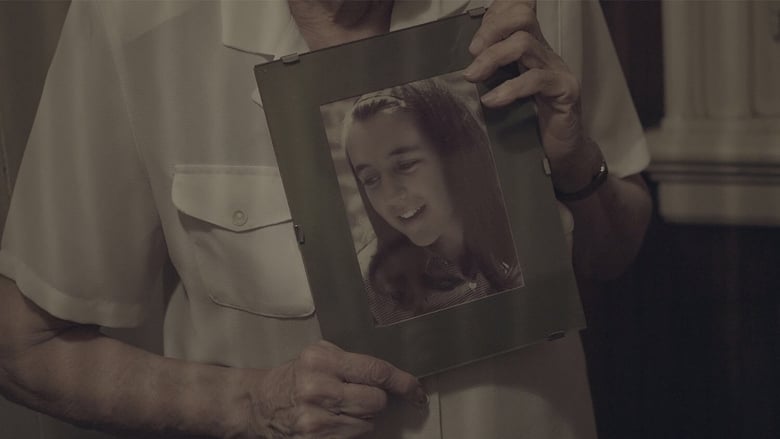
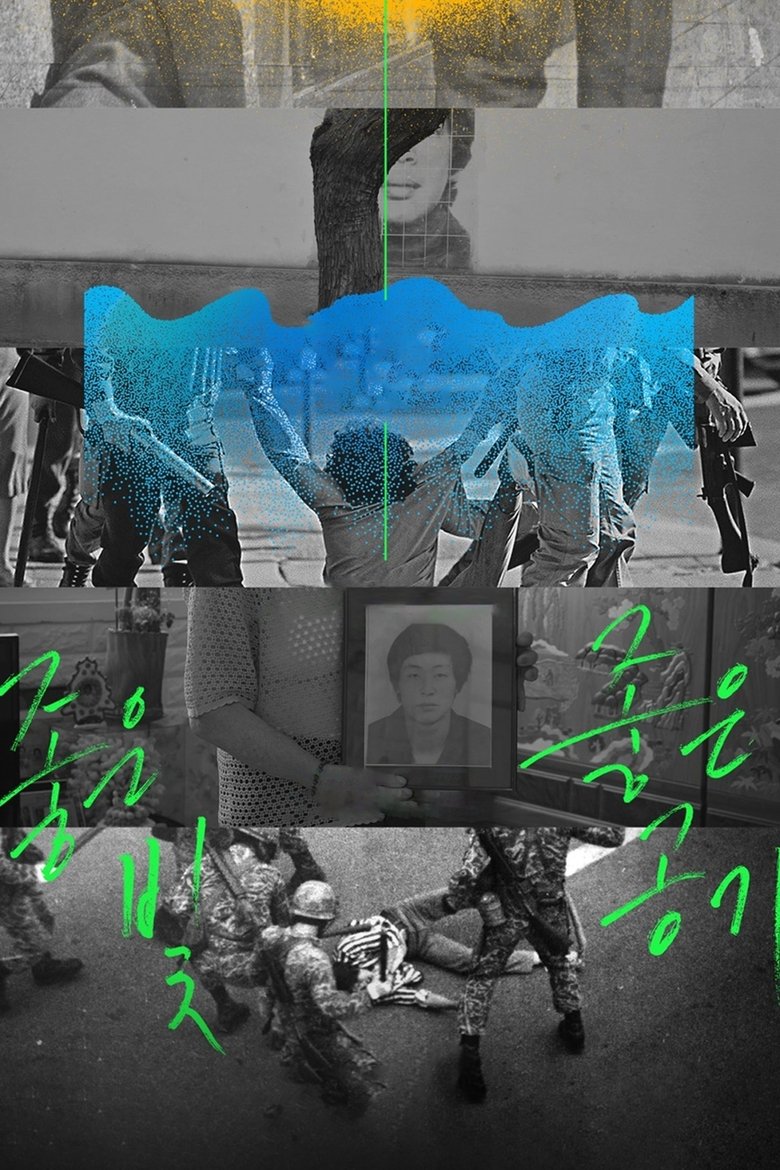
The title Good Light, Good Air is oddly paradoxical. Keenly working at the point where his artistic identity and persistent attention on modern Korean history meet, director Im in this film focused on where the history of oppression and struggle intersect between Gwangju and Buenos Aires. In both cities, a great number of people who fought against the dictatorship were slaughtered and disappeared. The people of both societies still live with that trauma. When the testimonies of the victims of the two cities cross over, the film gives us chills as the eerie history of the two is very similar. Through Good Light, Good Air, director Im asks us how we will remember the past from where we stand right now.
Details
Budget
$0
Revenue
$0
Runtime
115 min
Release Date
2021-04-28
Status
Released
Original Language
Korean
Vote Count
0
Vote Average
0
Cast
Meet the talented actors who bring the movie to life.
CHA CHO-GANG
차초강
CHU HYE-SEONG
추혜성
PARK YOO-DEOK
박유덕
KIM GIL-JA
김길자
Similar Movies
Explore movies similar to this one that you might also enjoy.
7.5
Messi
His teachers, coaches, childhood friends and Barça teammates, together with journalists, writers and prominent figures from the history of football, come together in a restaurant to analyze and pick apart Messi's personality both on and off the field, and to look back at some of the most significant moments in his life. Viewed from Álex de la Iglesia's unique perspective, Messi recreates the player's childhood and teenage years, from his very first steps, with a football always at his feet, through to the decision to leave Rosario for Barcelona, the separation from his family, and the role played in his career by individuals such as Ronaldinho, Rijkaard, Rexach and Guardiola.
2014-09-06 | es
0.0
The New Tango
The New Tango (El Nuevo Tango) was not shown in Argentina for a long time as it deals with the ascent of Argentinean president Hector Campora in May 1973, and features Cuban and Chilean presidents, Osvaldo Dorticos and Salvador Allende. A million people gathered on the Plaza de Mayo to acclaim the new President. One of Cámpora's first presidential actions was a granting of amnesty to political prisoners who where jailed during the dictatorship. On 28 May Argentina restored diplomatic relations with Cuba, which then received Argentine aid - such as food and industrial products - to break the United States embargo against Cuba.
1973-03-14 | es
3.5
Match 64: The Maracanã
A documentary following the day life of fans in Brazil on July 13, 2014: the day when Germany and Argentina met up in the finals of FIFA World Cup.
2015-06-08 | en
10.0
Caos de tránsito
Through testimonies and images, the crude reality of human rights in Argentina in democracy is portrayed and the role of the hegemonic means of communication to make causes and protests invisible ...
2018-10-09 | es
6.0
White Walls Say Nothing
Buenos Aires is a complex, chaotic city. It has European style and a Latin American heart. It has oscillated between dictatorship and democracy for over a century, and its citizens have faced brutal oppression and economic disaster. Throughout all this, successive generations of activists and artists have taken to the streets of this city to express themselves through art. This has given the walls a powerful and symbolic role: they have become the city’s voice. This tradition of expression in public space, of art and activism interweaving, has made the streets of Buenos Aires into a riot of colour and communication, giving the world a lesson in how to make resistance beautiful.
2017-05-02 | es
0.0
'78 Cup - The Power of Football
Documentary about the Football World Cup held in Argentina in 1978, focusing on the competition and behind the scenes of the most important soccer competition in the world. Two versions of the 1978 official film exist, the first "Copa 78 - O Poder do Futebol" was made by Brazilian directors Maurício Sherman and Victor di Mello in 1979 but was later withdrawn by FIFA because of its controversial content. The film includes an interview with Rodolfo Galimberti, one of the leaders of the Montoneros guerrilla group and also made accusations that the Argentinian competition organisation committee had deliberately hindered Brazilian chances of success by tampering with the pitch at Mar del Plata.
1979-11-12 | pt
6.3
Trabantem až na konec světa
The third installment in Dan Přibáň's series of travel documentaries describes the author's journey with his friends across South America in vehicles that are often notorious but cult in their own way. The charming dynamics of the group on screen are further enhanced by the high-quality craftsmanship.
2014-03-13 | cs
7.5
Rule Britannia
A detailed account of each of the details of the Malvinas War based on interviews, dramatic scenes, maps and other elements of historical roots without ignoring the historical antecedents from the 18th century that ended in this confrontation.
1996-04-25 | es
8.0
Santiago's Path: Disappearance and Death of Santiago Maldonado
Santiago Maldonado disappeared in the midst of repression against a Mapuche community that claimed to Luciano Benetton for his land. His body was found 78 days later. The need for truth and justice continues
2018-08-01 | es
6.2
Las cinéphilas
Six elderly retired women, two from Buenos Aires, Argentina; two from Montevideo, Uruguay; and two from Madrid, Spain, have something in common, despite their different interests and lives: they go to the movies almost every day.
2017-04-20 | es
0.0
Resistencia Cultural
2021-04-08 | es
8.0
Social Genocide
After the fall of the military dictatorship in 1983, successive democratic governments launched a series of reforms purporting to turn Argentina into the world's most liberal and prosperous economy. Less than twenty years later, the Argentinians have lost literally everything: major national companies have been sold well below value to foreign corporations; the proceeds of privatizations have been diverted into the pockets of corrupt officials; revised labour laws have taken away all rights from employees; in a country that is traditionally an important exporter of foodstuffs, malnutrition is widespread; millions of people are unemployed and sinking into poverty; and their savings have disappeared in a final banking collapse. The film highlights numerous political, financial, social and judicial aspects that mark out Argentina's road to ruin.
2004-03-18 | es
7.0
Fútbol Violencia S.A.
2009-04-23 | es
0.0
Our House in Cuba
There was a time in Argentina, not so long ago, when the army wasn't only one, official, but many and made up by civilians. In those times of courageous youths determined to fight to the death for that cause upheld around Peronism as wll as some left-wing postulates, revolutionary Cubas was a beacon of hope in the world scheme -a Montonero nation. "A House in Cuba" seeks to recover the curious adventure of a couple of Montonero parents and their small children, who were lovingly sent into exile in order for their parents to take up arms.
2015-11-15 | es
7.0
A House Without Curtains
María Estela Martínez, better known as Isabel Perón, achieved what Evita Perón never could: From an unknown cabaret dancer she became the first female president of the Americas. But after surviving prison and exile under South America’s most brutal military dictatorship, Isabel was forgotten in popular memory. “Una casa sin cortinas” (A House Without Curtains) uncovers why Isabel still haunts Argentina today.
2021-03-19 | es
0.0
Argentina... Argentina...
2006-03-27 | es
0.0
Sunset Boulevards
In this documentary about the exile of two famous French actors in Argentina during and after World War II, the director Cozarinsky returns to Argentina after many years in France and recalls places and events from his childhood, particularly the celebration of the liberation of Paris on in August of 1944, in Buenos Aires's Plaza Francia. Featuring testimony from various authors and acquaintances of Maria (Renee) Falconetti and Robert Le Vigan, the film explores their lives and final years in Argentina.
1992-08-01 | fr
0.0
Landwirtschaft in Südamerika - Argentinien
2018-01-02 | de
6.8
The Crazy Che
The incredible story of Bill Gaede, an Argentinian engineer, programmer… and Cold War spy.
2015-11-19 | es
0.0
Lionel Messi - The Drama of Argentina
2022-10-27 | pt