Loading
The True Story of King Tut's Tomb
Genres
Documentary
Overview
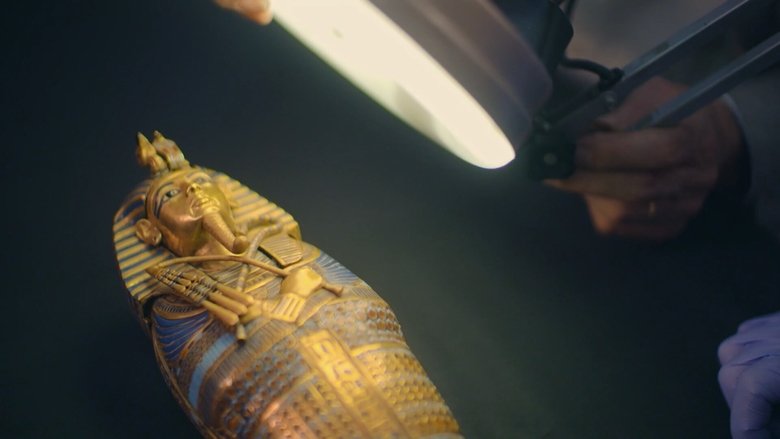
Almost 100 years after the discovery of King's Tut's Tomb, it is time to tell the story in a new light. Using 2D and 3D imagery to reconstruct the tomb, the mummy, the funerary objects and the topography of the famous valley of the Kings.
Details
Budget
$0
Revenue
$0
Runtime
53 min
Release Date
2019-04-10
Status
Released
Original Language
English
Vote Count
1
Vote Average
6
Cast
Meet the talented actors who bring the movie to life.
Similar Movies
Explore movies similar to this one that you might also enjoy.
0.0
Dávným Egyptem
1959-01-01 | cs
0.0
Egypt: The Treasure Of The Sacred Bulls
This documentary follows a team of archaeologists, mandated by the Louvre Museum, as they pick up where Egyptologist Auguste Mariette left-off with his discovery of the Serapeum tomb of the bull of Apis - one of the most sacred places in Saqqara, Egypt, in 1850. Mariette also managed to map out a network of underground tunnels leading to other burial sites that he did not have time to uncover. With exclusive access, we follow a team of archaeologists continue the research of Mariette.
2024-01-01 | en
9.0
Ägypten: Geburt einer Großmacht
2011-04-02 | de
8.0
Tutankhamun: The Mystery of the Burnt Mummy
2013-11-10 | en
7.0
Egypt's Sunken City – A Legend Is Revealed
Looking for a forgotten city: off the coast of Egypt, just a few metres under the surface, but blanketed by sand and mud, slumbers the ancient port of Heracleion.
2013-11-05 | de
7.7
Le Harem du Pharaon-Soleil
January 2011: a team from the University of Basel makes two spectacular discoveries. The first was a previously unknown tomb, which was given the number KV64 and contained two mummies. It had originally been created at the time of Amenhotep III for a princess of the 18th dynasty and was reused a few centuries later for the burial of a noblewoman of the 22nd dynasty. Right next to it is the already known burial site KV40, where the Basel researchers have now carried out excavations for the first time. They discovered dozens of mummies - an unusual find in the Valley of the Kings, where most tombs were built for just one pharaoh. Initially, the archaeologists estimated the number of dead at 30, but after months of collaboration with evolutionary scientist Frank Rühli from the University of Zurich, they came to the conclusion that there must actually be more than 90. Who were these women?
2017-12-30 | fr
7.0
Ägypten: Sehnsucht nach Unsterblichkeit
Around 3,000 BC, the first territorial state in history was created with the unification of Upper and Lower Egypt. The empire on the Nile was to exist for 3,000 years. The current section focuses on religion, temple economy and the cult of the dead and examines the reigns of Akhenaten and Ramses II. The culture of Ancient Egypt is characterized by religion, temple economy and the cult of the dead. Two pharaohs play an important role in this context: Akhenaten and Ramses II. When Akhenaten ascended the throne around 1,350 BC, religious customs in Egypt had hardly changed for almost 2,000 years. The influential priesthood was organized hierarchically and the rituals were set out in fixed rituals. The temples are not only the spiritual but also the economic centers of the country.
2011-04-09 | de
7.5
Secrets of Egypt's Lost Queen
Move over, King Tut: There's a new pharaoh on the scene. A team of top archaeologists and forensics experts revisits the story of Hatshepsut, the woman who snatched the throne dressed as a man and declared herself ruler. Despite her long and prosperous reign, her record was all but eradicated from Egyptian history in a mystery that has long puzzled scholars. But with the latest research effort captured in this program, history is about to change.
2007-01-01 | en
0.0
The Lost Pharaoh: The Search for Akhenaten
Ancient pharaoh Akhenaten was almost lost to history. Canadian archaeologist Donald Redford, who uncovered the foundation of one of the pharaoh’s many temples, attempts to finally piece together this great Egyptian ruler’s enigmatic story.
1980-11-30 | en
7.0
Nefertiti and the Lost Dynasty
It is one of Egypt's enduring mysteries. What happened to Nefertiti and her husband, Akhenaten - the radical king, and likely father of King Tut? In a dark and mysterious tomb located in the Valley of the Kings, there is a small chamber with two mummies without sarcophagi or wrappings. At times, both have been identified as Queen Nefertiti by scholars, filmmakers and historians. But the evidence has been circumstantial at best.
2007-07-16 | en
5.5
Engineering Egypt
Egypt's two greatest Pharaohs, Khufu and Ramesses II, built their way to immortality through architectural marvels including the temples of Abu Simbel and the Great Pyramid of Giza
2007-11-13 | en
7.0
The Giza Pyramids: Reaching for the Stars
Explores the Pyramids of Giza as Egyptologists try to unravel the mysteries and decipher the clues behind these stone giants built over 4,500 years ago.
2023-09-18 | fr
0.0
The Search for Tutankhamun
Howard Carter hunts for the tomb of the boy king Tutankhamun.
2005-10-30 | en
0.0
Isetenkheb's Egyptian Coffin
Follow from the amazing restoration process of one of the most cherished and mysterious pieces of History: an Egyptian sarcophagus covered with hieroglyphics (painted wood). With exclusive interviews of experts, art curators and restorators, discover everything about the story of the Isetenkheb coffin of Ancient Egypt dated from around 664-500 BC !
2022-03-03 | en
4.0
Le monde de Khéops
2018-02-17 | fr
7.5
Tutankhamun: The Truth Uncovered
What killed King Tutankhamun? Ever since his spectacular tomb was discovered, the boy king has been the most famous pharaoh of all ancient Egypt. But his mysterious death, at just 19 years old, has never been explained. In this BBC One special, presenter Dallas Campbell reveals new scientific research and carries out unique experiments to get to the truth. For the first time, a virtual autopsy of Tut's mummified body reveals astonishing secrets about the pharaoh. Using CT scan data, the programme creates the first ever full size, scientifically accurate image of the real Tutankhamun. Brand new DNA analysis uncovers a shocking secret about Tut's family background, and the genetic trail of clues leads to a radical and revolutionary new theory to explain Tut's sudden and unexpected death. This is an epic detective story that uncovers the extraordinary truth of the boy behind the golden mask.
2014-10-26 | en
7.0
Lost Treasures of the Ancient World: The Seven Wonders of the Ancient World
This program presents the stories of the works of architecture regarded by the Greeks and Romans as the most extraordinary structures of antiquity: the Hanging Gardens of Babylon, The Statute Of Zeus, the Temple of Artemis, the Mausoleum of Halicarnassus, the Pharos of Alexandria and the Pyramids of Egypt and more.
1999-01-01 | en
8.5
Rise of the Black Pharaohs
Around 800 BC, Kush, a little-known subject state of Egypt, rose up and conquered the Egyptians, enthroned its own Pharaohs, and ruled over the empire of King Tut for nearly 100 years. This unlikely chapter of history has been buried by the Egyptians and belittled by early archaeologists, who refused to believe that dark skinned Africans could have risen so high. But now, in the heart of Sudan, archeologists Geoff Emberling and Tim Kendall are bringing the truth about the Black Pharaohs to life.
2014-10-01 | en
7.0
Ramesses II: The Great Journey
3,200 years ago, Egypt is living the final hours of its golden age under the reign of Ramesses II. After ruling the country for 67 years, the great pharaoh dies at the old age of 92. His mummy is burried in the heart of the Valley of the Kings. This is the beginning of his great journey towards the afterlife but only under one condition: that his tomb remains off limits forever. However, in the 19th century, many European adventurers explore the tomb of the king searching for the burial chamber. Then begins an archeological investigation, which reveals the story of Ramesses II after-life.
2011-01-01 | en
6.0
Pyramid
Of the Seven Wonders of the Ancient World, the Pyramid is the only one to survive. Many believe that even with our 21st-century technology, we could not build anything like it today. Based on the most up-to-date research and the latest archaeological discoveries, here is how the Pyramid came to be.
2002-10-28 | en