Loading

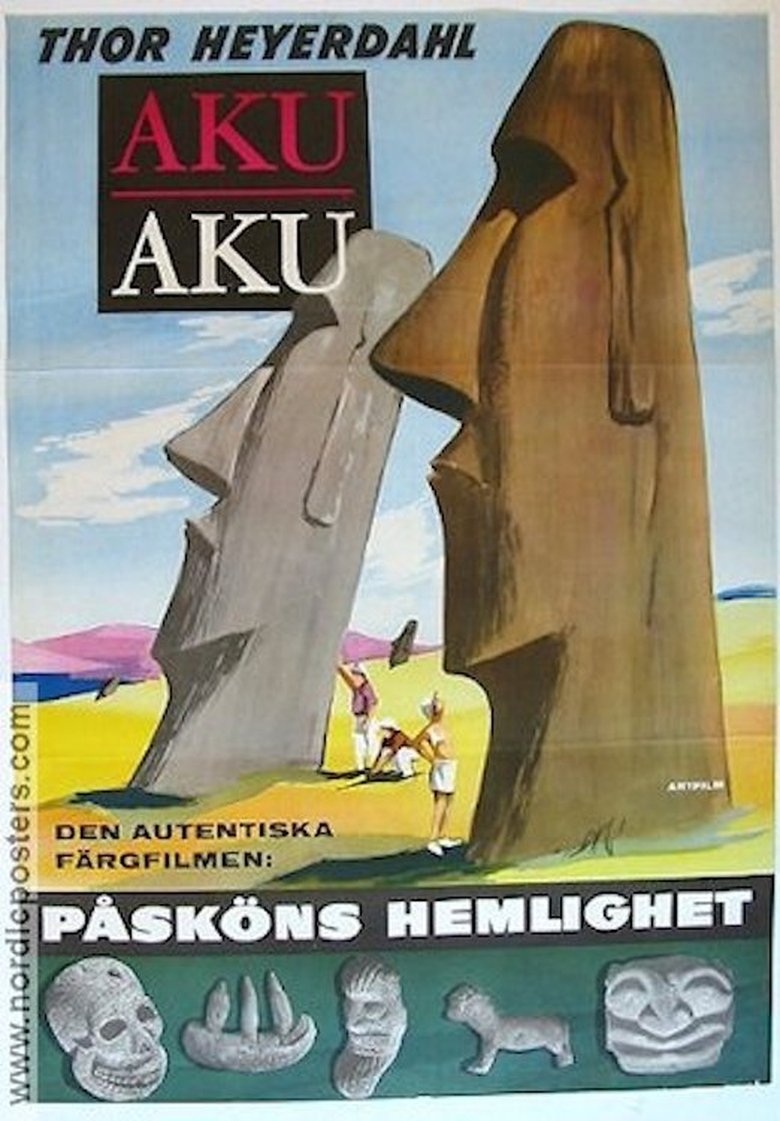
Aku-Aku
Genres
Documentary
Overview
Documentary following the 1955–1956 Norwegian Archaeological Expedition's investigations of Polynesian history and culture at Easter Island.
Details
Budget
$0
Revenue
$0
Runtime
86 min
Release Date
1960-01-22
Status
Released
Original Language
English
Vote Count
2
Vote Average
6.5
Cast
Meet the talented actors who bring the movie to life.
Similar Movies
Explore movies similar to this one that you might also enjoy.
0.0
Do země ledovců
Documentary film about the Czechoslovak natural science group's expedition to Iceland in June 1948.
1950-03-31 | cs
0.0
Skryté dějiny
A documentary about archaeology, which, based on traces and finds hidden underground, creates a picture of the beginnings of the history of the Czech lands, which goes back to the Ice Age 30,000 years ago.
1950-12-31 | cs
0.0
Nauru, an Island Adrift
A quiet island, lost in the pacific ocean. Nothing worth of interest, until the day a stroke of luck, phosphate, provided by the island's coral core, led the country to incredible heights: in 1975, it became the second richest country per inhabitant in the world after Saudi Arabia... Only to plunge into ruins a few years later.
2009-03-14 | fr
7.0
Treasures of the Anglo-Saxons
In this hour-long documentary, Oxford academic Janina Ramirez tours the country in search of Anglo-Saxon art treasures. Her basic thesis - and it is a plausible one - is that we should not look upon their era as a "dark age" as compared, for example, to Roman times, but rather celebrate it as an age in which creativity flowered, especially in terms of artistic design as well as symbolism. She shows plenty of good examples, ranging from the Franks Casket to the Staffordshire Hoard, and the Lindisfarne Gospels.
2010-08-10 | en
8.0
Iznik, les mystères de la basilique engloutie
2024-01-25 | fr
0.0
The Statue of Giordano Bruno
This film was made out of the capture of a live animation performance presented in Rome in January 2005 by Pierre Hébert and the musician Bob Ostertag. It is based on live action shooting done that same afternoon on the Campo dei Fiori where the philosopher Giordano Bruno was burned by the Inquisition in 1600. A commemorative statue was erected in the 19th century, that somberly dominate the market held everyday on the piazza. The film is about the resurgence of the past in this place where normal daily activities go on imperturbably. The capture of the performance was reworked, shortened and complemented with more studio performances.
2005-01-01 | en
10.0
How the Monuments Came Down
How the Monuments Came Down is a timely and searing look at the history of white supremacy and Black resistance in Richmond. The feature-length film-brought to life by history-makers, descendants, scholars, and activists-reveals how monuments to Confederate leaders stood for more than a century, and why they fell.
2021-06-10 | en
7.0
The Nobles of Prehistory: Ladies and Princes of the Paleolithic
In 1872, in the cave of Cavillon in Monaco, archaeologist Émile Rivière (1835-1922) unearthed an apparently very old human skeleton, at least 24,000 years old, a discovery that changed the modern image of prehistoric men and women.
2021-06-16 | fr
7.5
Easter Island Origins
How were the giant stone heads of Rapa Nui – also known as Easter Island – carved and raised, and why? Since Europeans arrived on this remote Pacific island over 300 years ago, controversy has swirled around the iconic ancient statues and the history of the people who created them. Now, a new generation of researchers is overturning old theories, revealing the rich history, innovation, and resilience of the Rapanui people, and uncovering intriguing new evidence about where they – and their practice of monumental stone building – came from.
2024-02-07 | en
6.0
The Legend of Tayos
A Hungarian explorer claims to have discovered a "Gold Library" inside a cave. Lacking evidence, he tries to get the recognition he believes he deserves but struggles to get support from the local governments and religious leaders.
2021-09-10 | es
0.0
Shepherds in the Cave
An international team of art restorers and archaeologists begin work on the restoration of medieval frescoes inside a network of ancient caves. Faced with local bureaucratic challenges and systemic neglect of archaeological sites, the team encounters a community of shepherds and migrants that have used the caves for centuries and discover a living culture worth preserving most of all.
2017-01-02 | en
0.0
Tut-ankh Amen's Tomb (Daily Sketch Topical Budget 600-1)
"No discovery of our time has so moved the whole world," proclaims an intertitle introducing this special extended newsreel edition. For once, Topical Budget's characteristic hyperbole is on the money. The discovery and excavation (some would say grave-robbing) of the tomb of the 14th Century BC Egyptian pharaoh was already an international sensation by the time this newsreel screened in February 1923. The sense of breathless excitement surrounding the discovery extends to Topical's intertitles, which expend a good portion of the film's running time explaining the relatively fleeting, poor quality images of the excavation itself. But we do get to see the removal of an ebony, ivory and gold chair, and two glimpses of expedition leader Howard Carter - in long-shot from behind as announced in an intertitle, but also a much clearer, unheralded shot at the 'halfway rest house', where he cuts a dash in white shirt and trousers.
1923-01-02 | en
7.2
Galapagos with David Attenborough
Two hundred years after Charles Darwin set foot on the shores of the Galápagos Islands, David Attenborough travels to this wild and mysterious archipelago. Amongst the flora and fauna of these enchanted volcanic islands, Darwin formulated his groundbreaking theories on evolution. Journey with Attenborough to explore how life on the islands has continued to evolve in biological isolation, and how the ever-changing volcanic landscape has given birth to species and sub-species that exist nowhere else in the world. Encompassing treacherous journeys, life-forms that forge unlikely companionships, and survival against all odds, Galápagos tells the story of an evolutionary melting pot in which anything and everything is possible.
2013-04-17 | en
8.0
Angkor et Les Mystères de L'Empire Khmer
2022-11-03 | fr
6.2
Tawai: A Voice from the Forest
Explorer Bruce Parry visits nomadic tribes in Borneo and the Amazon in hope to better understand humanity's changing relationship with the world around us.
2017-09-29 | en
0.0
The Donkey that Carried the Cloud on its Back
In the Indian Ocean, off the coast of Kenya, there is an island. On this island there is a stone town; its stone buildings stand as skeletons of the splendor of its yesteryears. High tide, low tide, Full moon, new moon. Lamu is an island frozen in time. Now Africa’s largest port is being constructed. In order to evolve, what part of ourselves do we keep and what part do we leave behind?
2015-12-31 | en
0.0
Ostseeparadies Rügen
The white chalk cliffs of Rügen are among the most impressive natural monuments on earth, which the painter Casper David Friedrich immortalized for posterity as early as the 19th century. Germany's largest island with its seaside resorts from the Gründerzeit, its smaller side islands and peninsulas that give it its shape, its lagoon-like Bodden waters, the dense beech forests, the yellow rapeseed fields and the meadows, the shady tree avenues and the white sandy beaches is not only a magnet for tourists, but also a unique natural paradise in the middle of the Baltic Sea, a habitat for the rare white-tailed eagle, fallow deer, raccoon dogs and badgers as well as a resting place for huge swarms of migratory birds such as geese and cranes that can be heard trumpeting from afar. In this nature documentary, the unique landscapes and the diversity of the animal world of Rügen are captured with beautiful pictures during the changing of the seasons.
2005-12-14 | de
7.0
Révélations Monumentales: Pétra, la rose du désert
2019-03-26 | fr
6.0
Survival Island
Standing almost alone in the great Southern Ocean, South Georgia island plays host to some of the largest concentrations of animals anywhere on Earth during the spring and summer months. This is the story of these vast animal cities, and of the order that lies beneath their seeming chaos.
1996-01-01 | en
0.0
I Wish
Hong Kong started and flourished as a fishing port in the past, and its people have long been committed to worshipping ancient deities for their blessings. With over a hundred Tin Hau temples (Goddess of Sea) in Hong Kong, there are three on Lamma Island alone, located respectively in Sok Kwu Wan, Luk Chau and Yung Shue Wan. The film documents the states of Tin Hau temples on the island and beyond, as an attempt to contextualise the everyday practice of the fishing community, islanders and city dwellers visiting the temples.
2022-11-11 | cn