Loading

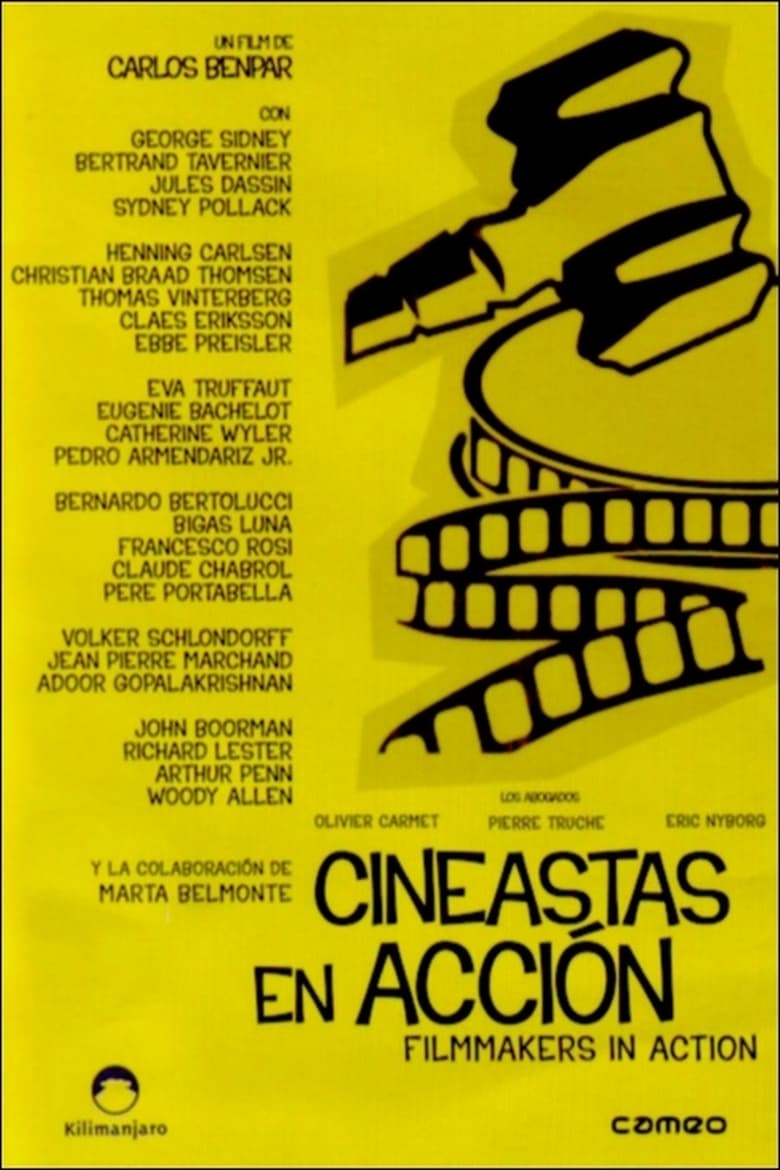
Filmmakers in Action
Genres
Documentary
Overview
What is the state of cinema and what being a filmmaker means? What are the measures taken to protect authors' copyright? What is their legal status in different countries? (Sequel to “Filmmakers vs. Tycoons.”)
Details
Budget
$0
Revenue
$0
Runtime
103 min
Release Date
2006-09-15
Status
Released
Original Language
Catalan
Vote Count
4
Vote Average
6.8
Cast
Meet the talented actors who bring the movie to life.
Marta Belmonte
Marta
Aitor Martínez
Boy #1
Lonan García
Boy #2
Pau Herrero
Boy #3
Gabriel Agustí
Cardinal
Mark San Juan
Clergyman
Vera Böhler
Girl
Julio de Pablo
Volterra
Adoor Gopalakrishnan
Self
Arthur Penn
Self
Bernardo Bertolucci
Self
Bertrand Tavernier
Self
Bigas Luna
Self
Catherine Wyler
Self
Christian Braad Thomsen
Self
Claes Eriksson
Self
Claude Chabrol
Self
Ebbe Preisler
Self
Eric Nyborg
Self
Eugenie Bachelor
Self
Eva Truffaut
Self
Francesco Rosi
Self
Håkan Sjöstrom
Self
Henning Carlsen
Self
Jean-Pierre Marchand
Self
John Boorman
Self
Jules Dassin
Self
Olivier Carmet
Self
Pedro Armendáriz Jr.
Self
Pere Portabella
Self
Pierre Truche
Self
Richard Lester
Self
Sydney Pollack
Self
Thomas Vinterberg
Self
Volker Schlöndorff
Self
Woody Allen
Self
George Sidney
Self (archive footage)
Howard Hawks
Self (archive footage)
Ingmar Bergman
Self (archive footage)
Jean-Luc Godard
Self (archive footage)
Salvador Dalí
Self (archive footage)
Sam Peckinpah
Self (archive footage)
Samuel Fuller
Self (archive footage)
William A. Wellman
Self (archive footage)
Similar Movies
Explore movies similar to this one that you might also enjoy.
7.1
The Arrival of a Train at La Ciotat
A group of people are standing along the platform of a railway station in La Ciotat, waiting for a train. One is seen coming, at some distance, and eventually stops at the platform. Doors of the railway-cars open and attendants help passengers off and on. Popular legend has it that, when this film was shown, the first-night audience fled the café in terror, fearing being run over by the "approaching" train. This legend has since been identified as promotional embellishment, though there is evidence to suggest that people were astounded at the capabilities of the Lumières' cinématographe.
1896-06-30 | fr
0.0
Citizen B
Documentary on Ciby 2000, the French film production company founded by Francis Bouygues in 1990.
2025-01-17 | fr
7.8
Zombies in the Sugar Cane Field: The Documentary
Tucumán, Argentina, 1965. Three years before George A. Romero's Night of the Living Dead was released, director Ofelio Linares Montt shot Zombies in the Sugar Cane Field, which turned out to be both a horror film and a political statement. It was a success in the US, but could not be shown in Argentina due to Juan Carlos Onganía's dictatorship, and was eventually lost. Writer and researcher Luciano Saracino embarks on the search for the origins of this cursed work.
2019-11-08 | es
0.0
Somewhere Between New York and LA
Since he was 18 years old, Blake Eckard has written and directed six feature length films in his hometown of Stanberry, Missouri (population 1186). Aside from a short distribution deal in Canada and a few festival screenings, his movies have largely gone unseen.
2020-11-08 | en
4.0
At the Coliseum Deluxe
A feature length documentary about Australian popular entertainment across 150 years; of Skating and Dancing, Vaudeville and Moving Pictures.
2019-11-03 | en
0.0
Hitlers Traum von Micky Maus - Zeichentrick unterm Hakenkreuz
The order comes in the summer of 1941 from propaganda minister Joseph Goebbels himself: The best animators are summoned to Berlin. Their task: Producing feature-length cartoons in ‘Disney-Quality’ with the newly founded ‘Deutsche Zeichenfilm GmbH’. To get trained, the Disney movie “Snow White” is re-traced frame by frame. After the final victory, one new feature-length production of quality shall be released every year from 1947 onwards. – that is the plan. Only in 1943, the first production is completed: “Armer Hansi” a 17-minute-long colour movie, realized with the effortful Multiplane-technology. The second film by the ‘Deutsche Zeichenfilm’ is only completed in 1946 – by DEFA. In the territories occupied by Germany, cartoons are produced as well, sometimes harmless ones, sometimes propagandistic ones. With excerpts from animated movies, life-action film documents, and witness reports by contemporaries, this documentary draws a picture of the cartoon production in the third Reich.
1999-01-01 | de
0.0
Inventory
A documentary by Olivier Gonard, shot partly in Paris’s Musée d’Orsay, that examines Olivier Assayas' film Summer Hours, and its approach to art.
2008-01-01 | fr
6.2
Hollywood Bulldogs: The Rise and Falls of the Great British Stuntman
They created and performed the iconic action sequences of 007, Indiana Jones, Superman, Rambo, Star Wars, Conan, the Alien films and pretty much everything since. They crashed cars, jumped from burning buildings, shot, stabbed, kicked and punched their way into cinema history. This is the first feature documentary to unite the legendary community of stuntmen in telling their story and, as you'll see, there's life in the old dogs yet.
2021-06-24 | en
7.2
Tin Tan
Germán Cipriano Gómez Valdés Castillo, a young radio announcer from Cuidad Juárez, succeeds in drawing attention to the pachuco movement through his character Tin Tan, laying the groundwork for a new form of binational and mass linguistic expression: Spanglish. He soon became a leading figure in theater and film on the American Continent. Singled out by critics as a destroyer of the language, he quickly won the approval of the public. His ability to improvise revolutionized the film industry. His talent as an actor, singer, dancer and comedian contributed to the Golden Age of Mexican Cinema. From El Hijo Desobediente to Capitán Mantarraya, from Cuidad Juárez to Havana, from mambo to rock, the legacy of Tin Tan makes him one of the great icons of Mexico today. This film tells his story as it has never been told before.
2010-11-12 | en
10.0
Jean Renoir: Part Two - Hollywood and Beyond
The second part of a BBC documentary on the latter half of the career of French director Jean Renoir.
1993-11-17 | en
0.0
Jean Renoir parle de son art
Three-part interview with French film director Jean Renoir, conducted by French New Wave director Jacques Rivette.
1961-11-11 | fr
7.3
The Rebellious Olivia de Havilland
The legendary British-American actress Olivia de Havilland (1916-2020), who conquered Hollywood in the thirties, challenged the film industry when, in 1943, she took on the all-powerful producer Jack Warner in court, forever changing the ruthless working conditions that restricted the essential rights and freedom of artists.
2021-07-02 | fr
10.0
Cartoons Go To War
This remarkable documentary dedicates itself to an extraordinary chapter of the second World War – the psychological warfare of the USA. America’s trusted cartoon darlings from the studios of Warner Bros., Paramount, and the “big animals” of the Disney family were supposed to give courage to the people at the homefront, to educate them, but also to simultaneously entertain them. Out of this mixture grew a genre of its own kind – political cartoons. Insightful Interviews with the animators and producers from back then elucidate in an amusing and astonishing way under which bizarre circumstances these films partially came into existence.
1996-04-26 | en
6.0
Jan Hus – Cesta bez návratu
2015-11-13 | cs
4.6
Nice Girls Don't Stay for Breakfast
In the late 1990s, iconic photographer Bruce Weber barely managed to convince legendary actor Robert Mitchum (1917-97) to let himself be filmed simply hanging out with friends, telling anecdotes from his life and recording jazz standards.
2019-02-27 | en
6.5
Verbatim: What Is a Photocopier?
A jaded lawyer wastes an afternoon trying to figure out if a dim-witted government employee has ever used a photocopier. All the dialogue in this short comes from an actual deposition filed with the Supreme Court of Ohio.
2014-01-17 | en
4.3
The First Emperor of China
This historical drama tells the story of Qin Shihuang, who unified China's vast territory and declared himself emperor in 221 B.C. During his reign, he introduced sweeping reforms, built a vast network of roads and connected the Great Wall of China. From the grandiose inner sanctum of Emperor Qin's royal palace, to fierce battles with feudal kings, this film re-creates the glory and the terror of the Qin Dynasty, including footage of Qin's life-sized terra cotta army, constructed 2,200 years ago for his tomb.
1989-01-01 | en
6.9
Shine a Light
Martin Scorsese’s electrifying concert documentary captures The Rolling Stones live at New York’s Beacon Theatre during their A Bigger Bang tour. Filmed over two nights in 2006 with an all-star team of cinematographers, the film combines dynamic performances with archival footage and rare glimpses behind the scenes, offering a vibrant portrait of the band’s enduring energy and legacy.
2008-04-04 | en
5.1
What the #$*! Do We (K)now!?
Amanda is a divorced woman who makes a living as a photographer. During the Fall of the year Amanda begins to see the world in new and different ways when she begins to question her role in life, her relationships with her career and men and what it all means. As the layers to her everyday experiences fall away insertions in the story with scientists, and philosophers and religious leaders impart information directly to an off-screen interviewer about academic issues, and Amanda begins to understand the basis to the quantum world beneath. During her epiphany as she considers the Great Questions raised by the host of inserted thinkers, she slowly comprehends the various inspirations and begins to see the world in a new way.
2004-04-23 | en
6.0
Keiko Kishi, Eternally Rebellious
Born in 1932, Keiko Kishi has been one of the first Japanese actresses known worldwide. Her decision to move to France and to marry director Yves Ciampi in 1957 – after he filmed her in Typhoon Over Nagasaki starring Jean Marais and Danielle Darrieux – caused a huge scandal in Japan. Despite this transgression, Keiko Kishi continued acting in her home country with Kon Ichikawa, Yasujiro Ozu, Masaki Kobayashi… building unique bridges between Japanese and European cultures. Free and rebellious, she emancipated herself from the many obstacles she encountered in the film industry, and created her own production company in her early twenties. Let’s look back at the story of a pioneer, an inspiration for many generations.
2023-10-16 | fr