Loading
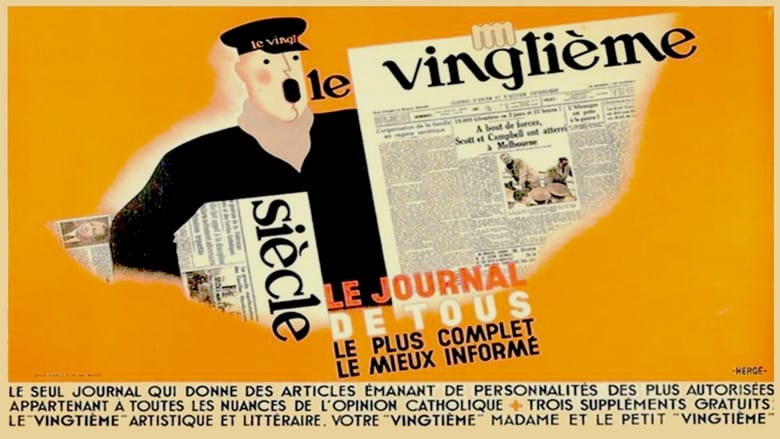

Le Petit Vingtième : le siècle de Tintin
Genres
DocumentaryTV Movie
Overview
From the beginning, Hergé's work, Tintin's creator, was conditioned by the ideology of his publisher, the weekly child supplement of a Belgian Catholic newspaper. An exciting analysis of the political meaning of the adventures of Tintin.
Details
Budget
$0
Revenue
$0
Runtime
58 min
Release Date
1995-01-01
Status
Released
Original Language
French
Vote Count
2
Vote Average
6
Cast
Meet the talented actors who bring the movie to life.
Frédéric Latin
Narrator (voice)
Pascal Ory
Self
Pierre Assouline
Self
Adolf Hitler
Self (archive footage)
Albert Einstein
Self (archive footage)
Hergé
Self (archive footage)
Similar Movies
Explore movies similar to this one that you might also enjoy.
6.2
Excellent Cadavers
Palermo, Sicily, 1984. Examining magistrate Giovanni Falcone allies with Tomasso Buscetta, a former mobster, to defeat the clan of Corleone, the ruthless Mafia faction that rules Cosa Nostra with an iron hand, cruelly eliminating all those who dare to oppose its immense power: other criminals, policemen, judges, even innocent civilians. One of them wants revenge, the other wants justice. But only one can survive such an unequal fight.
1999-10-16 | en
8.0
Japan's War in Colour
Using never-before-seen footage, Japan's War In Colour tells a previously untold story. It recounts the history of the Second World War from a Japanese perspective, combining original colour film with letters and diaries written by Japanese people. It tells the story of a nation at war from the diverse perspectives of those who lived through it: the leaders and the ordinary people, the oppressors and the victims, the guilty and the innocent. Until recently, it was believed that no colour film of Japan existed prior to 1945. But specialist research has now unearthed a remarkable colour record from as early as the 1930s. For eight years the Japanese fought what they believed was a Holy War that became a fight to the death. Japan's War In Colour shows how militarism took hold of the Japanese people; describes why Japan felt compelled to attack the West; explains what drove the Japanese to resist the Allies for so long; and, finally, reveals how they dealt with the shame of defeat.
2005-01-17 | en
0.0
Wie konnte es geschehen? - Teil 1: "Deutschland erwache..." (1914 - 1938)
In 1945, 160 German cities lay in ruins and the loss of millions of lives, billions in material assets and countless cultural treasures was mourned throughout Europe... With the question “How could it happen?”, the film goes back to the year 1914, when the “primal catastrophe of the 20th century” took its course with the First World War.
2006-01-01 | de
0.0
Emperors of Nothing
Emperors of Nothing is an unprecedented immersion within Forest, a prison in Brussels notorious for its inhumane incarceration conditions, bearing witness to how the human spirit resists or submits to this harsh world. Deeply personal and candid moments shared with inmates and wardens alike, those who have forfeited or devoted their lives to prison, expose universal truths of what it means to be "behind bars".
2024-05-08 | fr
7.2
Three Minutes: A Lengthening
The story of the only three minutes of footage —a home movie shot by David Kurtz in 1938— showing images of the Jewish inhabitants of Nasielsk (Poland) before the beginning of the Shoah.
2022-12-02 | en
6.0
One Rogue Reporter
Rich Peppiatt delivers a satirical dissection of the newspaper trade by turning the tables on unscrupulous editors. Through a series of mischievous stunts and interviews with heavyweights of journalism, comedy & politics, Peppiatt hilariously exposes the hypocrisy at the heart of modern journalism.
2014-06-08 | en
9.0
Novena
In 2012, Stephen Vaughan and Kay Ferreter are invited to address the congregation at St. Joseph's Redemptorists Church in Dundalk, Ireland for the Solemn Novena Festival. In a powerful speech, the pair describe their experiences being gay and lesbian in Ireland, feeling excluded by Catholic doctrine, and the importance of a more inclusive church.
2013-08-14 | en
5.0
Back Home
During World War II, young Rusty was sent to America for safety. It's now five years later and the spunky redhead returns to her native England. From the family she hardly remembers to snobby classmates and rule-filled boarding schools, Rusty must adapt to a whole new way of life.
1989-07-23 | en
0.0
Belgium - 20
What happens when a world that relies on traffic and the logistics that allow it comes to a standstill? What happens when sickness and even death are taken from us?
2021-08-28 | fr
3.3
Touch and Die
Martin Sheen stars as an American newsman in Rome who begins to investigate the appearance of several corpses found throughout Europe with their hands cut off. He soon uncovers not only plots of plutonium theft, but also of nuclear arms deals and dark political schemes.
1991-01-01 | en
7.8
Leningrad. Stimmen einer belagerten Stadt
It was one of the great crimes of the Second World War: from 1941 to 1944, a total of 872 days, the siege and starvation of Leningrad by the German Wehrmacht on Hitler's orders lasted. Over a million people fell victim to the blockade, most of them dying of hunger. Countless of these starving people wrote diaries with the last of their strength, and cameramen filmed in the paralyzed city. Evidence from the hell of the siege, many of the film recordings, but above all the written memories on which this documentary on the occasion of the 80th anniversary of the liberation is based, remained under lock and key after the war. The voices of those who had suffered through this terrible time should not be heard by anyone, because they did not fit the pathos of the Leningrad heroic song that was officially sung. Most of the recordings come from women. The writers feared neither the enemy nor the Communist Party or Stalin, who often proved incompetent in providing for the population.
2024-01-09 | de
0.0
Perifaquadro
Far beyond Marvel and DC, comics are also made by Brazilians for Brazilians. Follow the journey and struggles of those who are from the outskirts of the city and try to make a living from this art.
2022-12-15 | pt
6.3
A Hole In The Head
A pig farm in Lety, South Bohemia would make an ideal monument to collaboration and indifference, says writer and journalist Markus Pape. Most of those appearing in this documentary filmed in Slovakia, the Czech Republic, Poland, France, Germany and Croatia have personal experience of the indifference to the genocide of the Roma. Many of them experienced the Holocaust as children, and their distorted memories have earned them distrust and ridicule. Continuing racism and anti-Roma sentiment is illustrated among other matters by how contemporary society looks after the locations where the murders occurred. However, this documentary film essay focuses mainly on the survivors, who share with viewers their indelible traumas, their "hole in the head".
2017-03-16 | cs
6.0
Històries de Bruguera
The history of Bruguera, the most important comic publisher in Spain between the 1940s and the 1980s. How the characters created by great writers and pencilers became Spanish archetypes and how their strips persist nowadays as a portrait of Spain and its people. The daily life of the creators and the founding family, the Brugueras. The world in which hundreds of vivid colorful paper beings lived and still live, in the memory of millions, in the smile of everyone.
2012-04-20 | es
7.0
Messenger on a White Horse
Explores the life and work of English journalist Robert Cox, the former editor of "The Buenos Aires Herald" daily newspaper, whose investigative reporting in the late 1970s exposed the shocking human rights crimes of Argentina's military dictators.
2017-10-12 | en
8.0
The Death of Hitler: The Story of a State Secret
On April 30, 1945, while the Russian Army surrounded Berlin, Hitler committed suicide in his bunker. His body was discovered a few days later by the Soviets. He would be positively identified after a top secret inquest in which Hitler's personal dentist would play a central role. And yet, at the same time, Stalin publicly declared that his army was unable to find the Führer's body, choosing to let the wildest rumors develop and going so far as to accuse some of his Allies of having aided the monster's probable escape. What secrets were hidden behind this dissimulation? What happened then to the two ladies involved in the identification of Hitler’s body?
2017-04-07 | fr
0.0
An Island Invaded
Five Guamanians interviewed in the early 2000s recall the Japanese bombing of Guam on 7 December 1941, and the years of food shortages, abuses, and other hardships that followed. They describe their childhood lives before, during, and after the island's occupation by Japanese soldiers.
2004-01-01 | en
0.0
Łódź Ghetto
The Polish city of Łódź was under Nazi occupation for nearly the entirety of WWII. The segregation of the Jewish population into the ghetto, and the subsequent horrors are vividly chronicled via newsreels and photographs. The narration is taken almost entirely from journals and diaries of those who lived–and died–through the course of the occupation, with the number of different narrators diminishing as the film progresses, symbolic of the death of each narrator.
1989-03-22 | en
0.0
U-505: Extend the Experience
This video invites you inside the U-505 submarine, the actual craft that stalked the waters of the Atlantic before it was blown to the surface and captured on June 4, 1944. This immersive video reveals the technology and life aboard this sub in the days leading up to her capture. Among the many highlights, you’ll see crewmen bunks and the galley, wedged in among the mechanical workings of the sub.
2006-10-01 | en
0.0
The Forger
Adolfo Kaminsky started saving lives when chance and necessity made him a master forger. As a teenager, he became a member of the French Resistance and used his talent to save the lives of thousands of Jews. The Forger is a well-crafted origin story of a real-life superhero.
2017-05-05 | en