Loading

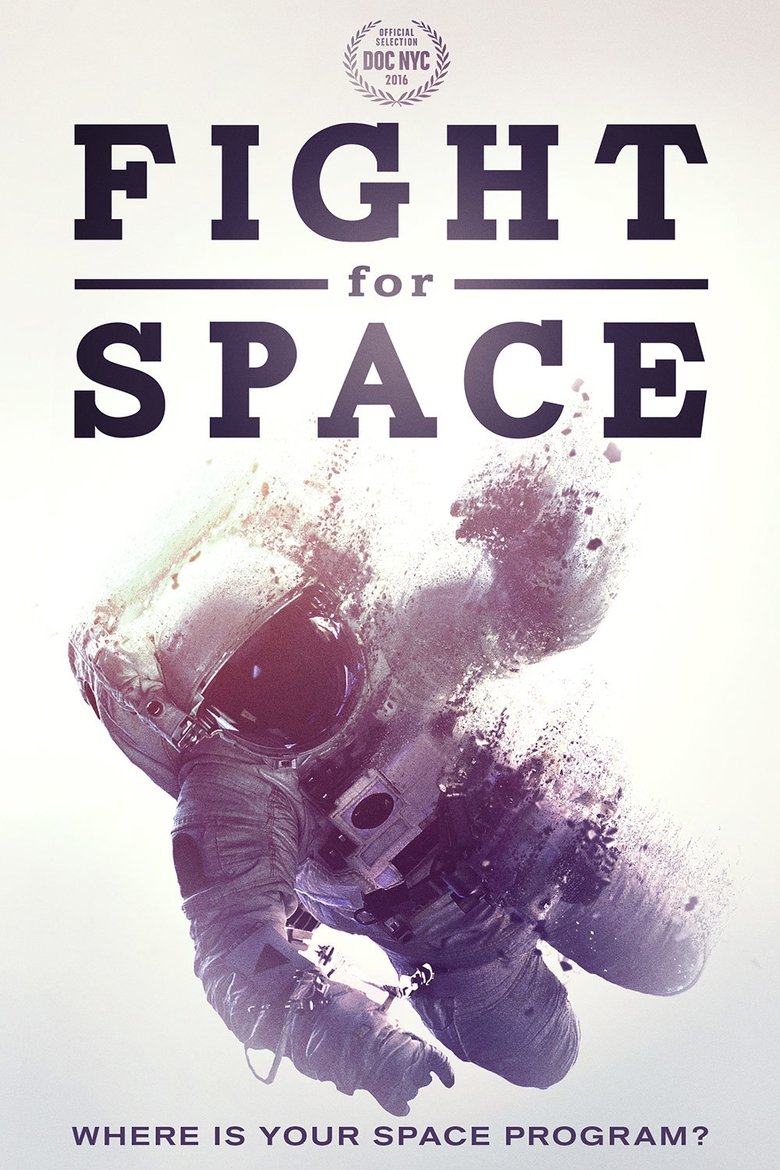
Fight For Space
Where Is Your Space Program?
Genres
Documentary
Overview
In 1962, spurred by the Cold War, President John F. Kennedy famously made the bold proclamation that NASA would send astronauts to the moon by the end of the decade, not because it was easy, but because it was a challenge. The Space Race inspired a generation to pursue careers in science and technology, but as the balance of world power shifted, interest in space exploration declined. "Fight for Space" serves as an urgent call to re-awaken our sense of wonder and discovery.
Details
Budget
$0
Revenue
$0
Runtime
92 min
Release Date
2016-11-14
Status
Released
Original Language
English
Vote Count
10
Vote Average
7.6
Cast
Meet the talented actors who bring the movie to life.
Neil deGrasse Tyson
Self
Bill Nye
Self
Michio Kaku
Self
Jim Lovell
Self
Gene Kranz
Self
Lawrence Krauss
Self
Robert Zubrin
Self
Leroy Chiao
Self
Story Musgrave
Self
Rick Tumlinson
Self
Marcia Smith
Self
Similar Movies
Explore movies similar to this one that you might also enjoy.
9.0
The Subject and Tasks of Biophysics
Experimental educational film reveals the emergence of some ideas of Biophysics in historical, philosophical and methodological aspects. The first film from the Biophysics Cycle (1982-1989).
1982-01-01 | ru
6.6
The Last Man on the Moon
The 1960s was an extraordinary time for the United States. Unburdened by post-war reparations, Americans were preoccupied with other developments like NASA, the game-changing space programme that put Neil Armstrong on the moon. Yet it was astronauts like Eugene Cernan who paved the uneven, perilous path to lunar exploration. A test pilot who lived to court danger, he was recruited along with 14 other men in a secretive process that saw them become the closest of friends and adversaries. In this intensely competitive environment, Cernan was one of only three men who was sent twice to the moon, with his second trip also being NASA’s final lunar mission. As he looks back at what he loved and lost during the eight years in Houston, an incomparably eventful life emerges into view. Director Mark Craig crafts a quietly epic biography that combines the rare insight of the surviving former astronauts with archival footage and otherworldly moonscapes.
2016-02-26 | en
8.0
Die rätselhafte Krankheit – Leben mit ME/CFS
ME/CFS is a devastating disease that affects around 300,000 people in Germany alone. There has been little help for sufferers to date. Many doctors are not familiar with the clinical picture and treat it incorrectly. However, something has been happening recently, partly due to the coronavirus pandemic: because the late effects of Covid-19 correspond to the typical symptoms of ME/CFS...
2021-07-10 | de
7.1
Tesla
Meet Nikola Tesla, the genius engineer and tireless inventor whose technology revolutionized the electrical age of the 20th century. Although eclipsed in fame by Edison and Marconi, it was Tesla's vision that paved the way for today's wireless world. His fertile but undisciplined imagination was the source of his genius but also his downfall, as the image of Tesla as a mad scientist came to overshadow his reputation as a brilliant innovator.
2016-10-18 | en
6.0
Pyramid
Of the Seven Wonders of the Ancient World, the Pyramid is the only one to survive. Many believe that even with our 21st-century technology, we could not build anything like it today. Based on the most up-to-date research and the latest archaeological discoveries, here is how the Pyramid came to be.
2002-10-28 | en
7.8
Sally
Sally Ride's groundbreaking journey as the first American woman in space concealed a deeply personal story. Her life partner, Tam O'Shaughnessy, unveils their covert 27-year romance and its accompanying sacrifices.
2025-01-28 | en
5.4
The Creeping Garden
An award-winning feature-length creative documentary exploring the extraordinary world of the plasmodial slime mould through the eyes of the fringe scientists, mycologists and artists. In recent years this curious organism has become the focus of much research in such areas as biological-inspired design, emergence theory, unconventional computing and robot engineering.
2014-07-27 | en
0.0
When We Were Shuttle
Explores the Shuttle Program through the eyes of some of the exceptional men and women who worked behind-the-scenes to make it fly. A unique and intimate portrait of the Shuttle Years, their recollections and personal archives reveal their fondest memories and darkest hours: from the launching and repair of the Hubble Space Telescope and the construction of the International Space Station, to the loss of Shuttles Challenger and Columbia in accidents that were ultimately seen as avoidable, and in many ways served as the impetus for the fleet’s early retirement.
2022-11-03 | en
7.0
In The Womb
In The Womb is a 2005 National Geographic Channel documentary that focus on studying and showing the development of the embryo in the uterus. The show makes extensive use of Computer-generated imagery to recreate the real stages of the process.
2005-01-01 | en
8.5
Take the World From Another Point of View
In 1973 Yorkshire public television made a short film of the Nobel laureate while he was there. The resulting film, Take the World from Another Point of View, was broadcast in America as part of the PBS Nova series. The documentary features a fascinating interview, but what sets it apart from other films on Feynman is the inclusion of a lively conversation he had with the eminent British astrophysicist Fred Hoyle.
1973-01-01 | en
0.0
DNA: Secret of Photo 51
On April 25, 1953, James Watson and Francis Crick published their groundbreaking discovery of the double helix structure of DNA. But their crucial breakthrough depended on the pioneering work of another biologist, Rosalind Franklin. 50 years later, NOVA investigates the shocking truth behind one of the greatest scientific discoveries and presents a moving portrait of a brilliant woman in an era of male-dominated science.
2007-04-24 | en
7.0
An Inconvenient Truth
A documentary on Al Gore's campaign to make the issue of global warming a recognized problem worldwide.
2006-05-24 | en
0.0
How the Telephone Talks
"All sounds travel in waves much the same as ripples in water." Educational film produced by Bray Studios New York, which was the dominant animation studio based in the United States in the years surrounding World War I.
1919-04-27 | en
7.2
Heal
A documentary film that takes us on a scientific and spiritual journey where we discover that by changing one's perceptions, the human body can heal itself from any disease.
2017-10-20 | en
0.0
Mastodon in your Backyard
A documentary about the 1999 discovery of a Mastodon skeleton in a Hyde Park backyard.
2001-09-30 | en
7.0
The Wonderful: Stories from the Space Station
In unusual circumstances, scientists from different countries work together to achieve a common scientific goal. Locked in their spinning space lab, they are isolated from the world — family and friends - and can only watch from the outside as life on Earth continues without them. The space station is a monument not only to the weaknesses of humanity, but also to its ability to do the impossible for the sake of life in space.
2021-09-10 | en
4.8
Uncensored Science: Bill Nye Debates Ken Ham
Bill Nye and Ken Ham debate whether creation is a viable model of origins in today's modern scientific era.
2014-02-04 | en
7.2
Stem Cell Universe With Stephen Hawking
The use of embryonic stem cells has ignited fierce debate across the spiritual and political spectrum. But what if we could create manmade stem cells - or find super cells in adults that could forever replace embryonic cells and remove the controversy? Today, we are on the brink of a new era - an age where we may be able to cure our bodies of any illness. Stephen HAWKING has spent his life exploring the mysteries of the cosmos, now there is another universe that fascinates him - the one hidden inside our bodies - our own personal galaxies of cells.
2014-02-03 | en
5.1
Th (Part 11: Dr. Helen Caldicott)
Dr. Helen Caldicott is the most prominent anti-nuclear activist in the world. She's been featured on CNN, 60 Minutes, CBC and Democracy Now. In the 80s, Helen Caldicott campaigned against nuclear weapons testing in the pacific (still responsible today for the majority of tritium we're exposed to), and against the notion of a winnable nuclear war. She was nominated for a Nobel Peace Prize for her efforts. She has always made inaccurate statements regarding civilian nuclear power. But, since the Fukushima-Diachii radiation release has caused (and is projected to cause) zero fatalities... http://www.unis.unvienna.org/unis/en/... ...her tone has changed when speaking to supporters. This has not been acknowledged by prime-time media, as they continue to use her as a source. Any person or media outlet should check Caldicott's history of statements (on any subject) against a domain expert before using her as a source.
2014-05-28 | en
5.0
Holy Land: Startup Nations
With the most tech startups and venture capital per capita in the world, Israel has long been hailed as The Startup Nation. WIRED’s feature-length documentary looks beyond Tel Aviv’s vibrant, liberal tech epicenter to the wider Holy Land region – the Palestinian territories, where a parallel Startup Nation story is emerging in East Jerusalem, Nazareth, Ramallah and other parts of the West Bank, as well as in the Israeli cybersecurity hub of Be’er Sheva. And we will learn how the fertile innovation ecosystem of Silicon Wadi has evolved as a result of its unique political, geographical and cultural situation and explore the future challenges – and solutions – these nations are facing.
2017-03-28 | en