Loading

Yankee Doodle Goes to Town
Genres
HistoryDrama
Overview
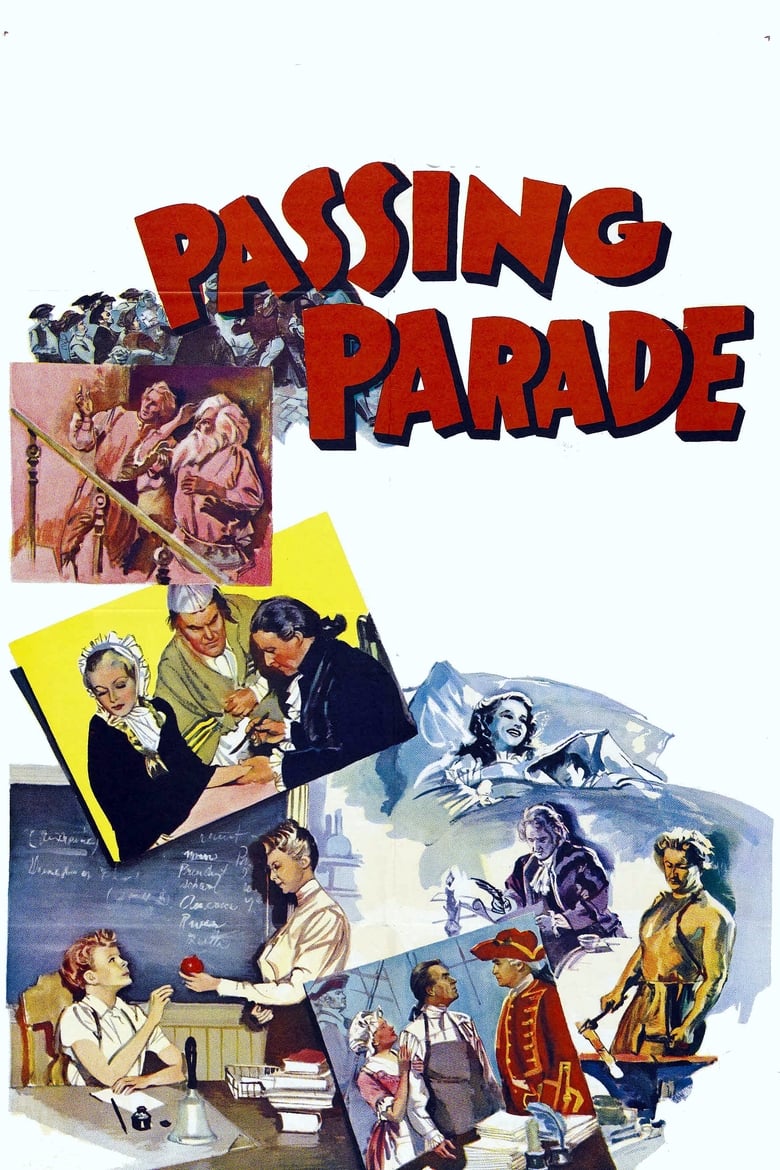
Made just before America would be forced into the Second World War, this short subject is a brief dramatized history of American democracy. It targets a perceived threat to democracy from board room and soapbox fascists who advocated a government based upon contemporaneous European models.
Details
Budget
$0
Revenue
$0
Runtime
11 min
Release Date
1939-06-17
Status
Released
Original Language
English
Vote Count
0
Vote Average
0
Cast
Meet the talented actors who bring the movie to life.
John Nesbitt
Narrator (voice)
Clem Bevans
Curdleface (uncredited)
Joe Devlin
Bartender (uncredited)
Robert Dudley
Shopkeeper (uncredited)
Albert Russell
Abraham Lincoln (uncredited)
Similar Movies
Explore movies similar to this one that you might also enjoy.
0.0
Jana Nayagan
2026-01-08 | ta
6.8
Danton
Danton and Robespierre were close friends and fought together in the French Revolution, but by 1793 Robespierre was France's ruler, determined to wipe out opposition with a series of mass executions that became known as the Reign of Terror. Danton, well known as a spokesman of the people, had been living in relative solitude in the French countryside, but he returned to Paris to challenge Robespierre's violent rule and call for the people to demand their rights. Robespierre, however, could not accept such a challenge, even from a friend and colleague, and he blocked out a plan for the capture and execution of Danton and his allies.
1983-01-12 | fr
5.5
Mr. Whitney Had a Notion
Historical short showing how Eli Whitney (best known for the invention of the cotton gin) played a significant role in the introduction of mass production techniques to the USA in the late 18th century.
1949-05-07 | en
7.0
To My Unborn Son
A Yugoslav man, dying after being shot while attempting to help defend his village, writes a letter of encouragement and hope to his unborn child, explaining what he was fighting for in resisting the Nazi invasion of his homeland. A John Nesbitt's Passing Parade short.
1943-10-30 | en
5.0
Strange Testament
This MGM Passing Parade series short tells the story of Julian Poydras, whose encounter with a girl at Mardi Gras had a profound effect on his later life.
1941-11-15 | en
6.0
Madero of Mexico
This Passing Parade series short chronicles the political life of Francisco Madero, who tried to bring democracy and land reform to Mexico.
1942-11-28 | en
0.0
That's Why I Left You
Young couple Joe and Mary Thompson love each other and their children despite the struggles that they have that are typical of most young couples early on in their married life, such as the basics of trying to make ends meet. But after Joe leaves Mary and their inner city life, she finds an unpostmarked envelope under their apartment door with her name written in Joe's handwriting. It contains a letter explaining why he left. It has primarily to do with his feeling that another part of his life was being left behind for his married life, that other life which consists of a want to travel, especially sail the south seas. The actual impetus to leave was inadvertently fostered by Mary through the birthday present she bought for him. So what actually did happen to Joe and will he ever return to his loving wife?
1943-06-12 | en
6.5
The Great American Mug
This John Nesbitt's Passing Parade short takes a look at the typical American barbershop throughout the years.
1945-10-06 | en
0.0
News Without A Newsroom
As local newsrooms vanish, "News Without a Newsroom" explores journalism's uncertain future in the digital age. Through powerful stories and expert insights, the film examines the collapse of traditional media, the rise of misinformation, and the fight to preserve truth, trust and accountability in an era of disruption.
2025-04-11 | en
4.0
The Story That Couldn't Be Printed
This John Nesbitt's Passing Parade short tells the story of John Peter Zenger, who in Colonial New York was tried for sedition based on what he printed in his newspaper.
1939-07-22 | en
0.0
The Hidden Master
Shows how important luck can be in a person's life.
1940-04-20 | en
4.0
Our Old Car
In this John Nesbitt's Passing Parade short, a man traces his history by the succession of cars his father owned. [This short appears in its entirety during MGM's short feature "The Great Morgan".]
1946-06-11 | en
6.0
The Story of Alfred Nobel
This John Nesbitt's Passing Parade short tells the story of Alfred Nobel, who invented dynamite, and later established the Nobel Prize.
1939-02-18 | en
0.0
American Spoken Here
This MGM John Nesbitt's Passing Parade series short takes a look at the origins of North American slang.
1940-11-30 | en
0.0
One Against the World
This short film presents the story of Dr. Ephraim McDowell, who came under scrutiny for his pioneering of surgical practices.
1939-08-19 | en
0.0
12 March: Rematch
Demirkırat stumbled on March 12, 1971. Actually, you know, they shoot limping horses. But this time it didn't. Turkish democracy continued to run despite its wounds. Because March 12 was not a "seizure" but a "warning". The generals were saying, "If what we want is not done, we will seize it." The country was entering a new era under this Sword of Damocles. A president who was helpless in the face of events, a prime minister who had to leave his seat, a newly fallen parliament, four generals neither inside nor outside the power... Now, a solution would be tried to be found out of this complex equation. But how and with whom? No one knew the answer to these questions in Turkey on the morning of March 13.
1994-06-12 | tr
0.0
Jamoora
Follows Shyam Rangeela, a stand-up comedian infamous for his Narendra Modi impersonation, and his daring pursuit of filing the general election nomination from the same constituency as the incumbent prime minister of India.
2024-10-11 | hi
0.0
Demirkırat: Coup
While the government was in a deep sleep, the brain staff of the revolution was completing its final preparations at the Military Academy, there were only a few hours left for the revolution that had been prepared for six years. Despite six years of preparation, there was actually no serious plan at hand. An unplanned, unscheduled full night raid was to be organized. The management level of the army was pro-government. Therefore, it was impossible for the intervention to take place within the chain of command. This was to be a grassroots military operation. The army of the operation consisted of young cadets. Except for the Harbiye, there was no force at hand. It was even possible for units such as the Guards Regiment and the Central Command to resist. That's how the day of May 27 began with the unknown and risks. Major General Cemal Madanoğlu, the commander of the Revolution Headquarters, would have the last word...
1991-07-09 | tr
0.0
We Do It Because
This John Nesbitt's Passing Parade short explores the origins of various customs such as shaking hands, kissing, and why ships are christened.
1942-01-24 | en
5.8
The Professor and the Story of the Origami Girl
A director feels he is about to lose himself to the market forces and thinks that the only way he can protest is by making a political film. He contacts Thomas Hylland Eriksen, who will become his mouthpiece and articulate what is wrong. But along the way the director becomes distracted by another person, a young, fumbling girl reminiscent of himself.
2005-06-10 | nb