Loading

Symphonie einer Weltstadt
Genres
Documentary
Overview
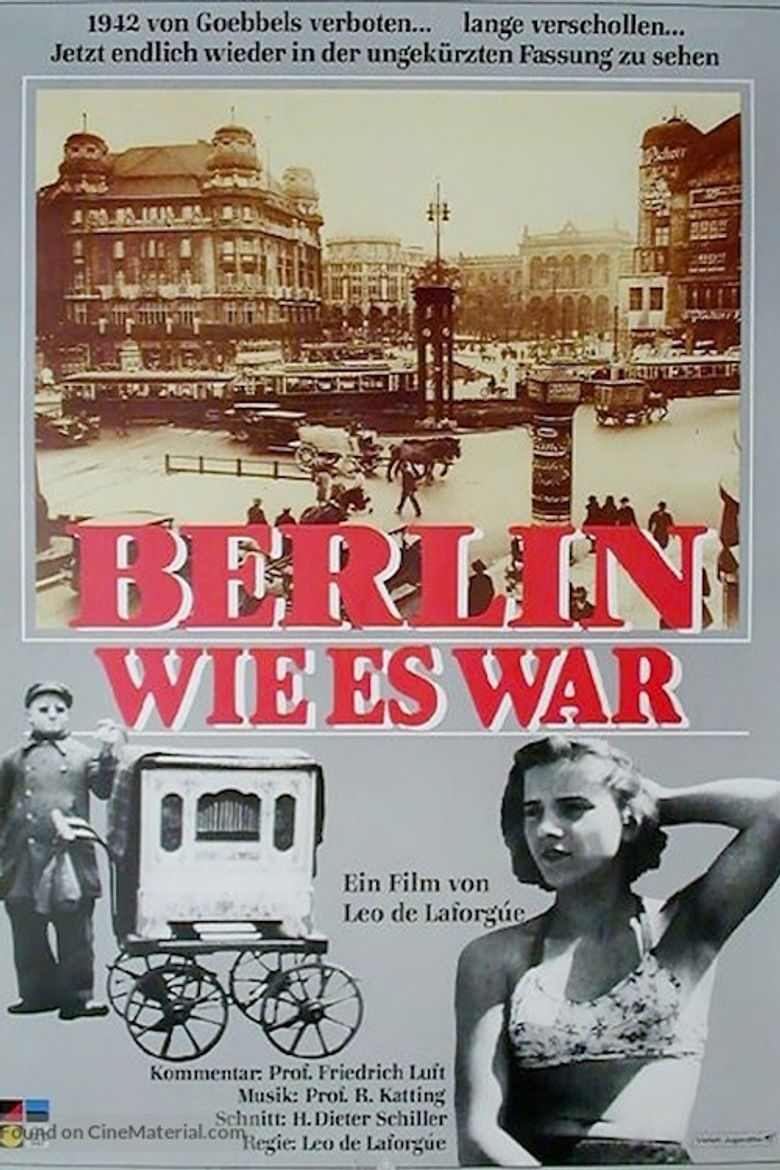
Documentary about the life in Berlin in 1941. The planned premier was stopped by the national party due to the damages and painful changes to the city that soon followed. It thus premiered in 1950.
Details
Budget
$0
Revenue
$0
Runtime
87 min
Release Date
1950-10-01
Status
Released
Original Language
German
Vote Count
1
Vote Average
6
Cast
Meet the talented actors who bring the movie to life.
René Carol
himself
Madeleine Lohse
herself
Friedrich Luft
voice
Paul Edwin Roth
voice
Similar Movies
Explore movies similar to this one that you might also enjoy.
0.0
Das Haus hinter dem Kupfergraben
The documentary portrays the art historian Wilhelm von Bode as a realistic visionary.
1988-12-31 | de
0.0
Museum für Deutsche Geschichte. Einblicke und Begegnungen
In 1952, the Central Committee of the Socialist Unity Party of Germany (SED) decides to establish a "Museum of German History" (MfDG) in the Zeughaus Unter den Linden. As the central history museum of the GDR, it is committed to the Marxist-Leninist conception of history. The film Museum of German History. Insights and Encounters - a GDR television documentary from 1988 - shows the reconstruction of the war-damaged building, presents selected eras such as the Peasants' Wars and the Revolution of 1848 and observes the preparations for a special exhibition on "Artists in the Class Struggle". The film also provides insights into the restorers' workshops, the coin collection and the painting depot.
1988-01-01 | de
0.0
Peter Eisenman: Building Germany's Holocaust Memorial
This documentary explores the creation of the Holocaust Memorial in Berlin as designed by architect Peter Eisenman. Reaction of the German public to the completed memorial is also shown.
2009-02-20 | en
8.0
Jesse Owens et Luz Long : le temps d'une étreinte
2015-06-10 | fr
3.0
Queens Don’t Cry
Bosom buddies BeV StroganoV, Ovo Maltine, Ichgola Androgyn and Tima die Göttliche are four Berlin drag queens who met in the mid 1980s. These four queens became Germany’s most popular drag performers and have been busy fertilizing the German cultural scene. Besides being performers, they are also political activists – in AIDS awareness, anti-gay violence, the sex workers movement and the struggle against the extreme right and racism. The film tells their story.
2002-02-09 | de
0.0
Partisan
Volksbühne am Rosa-Luxemburg-Platz 1992-2017. The end of the GDR gave rise to new artistic freedoms in reunited Berlin. Shortly after the fall of the Wall, rebel director Frank Castorf was appointed artistic director of the Volksbühne. His way of working altered the public’s perception of this theater. The chronological history of the Castorf era between 1992 and 2017 is told here in excerpts from the productions and in a series of conversations conducted on the long sofa in the theater's foyer.
2018-02-21 | de
3.6
Dragan Wende - West Berlin
Dragan Wende has lived in Berlin since the '70s and has seen the city change through the years. His nephew comes to live with him as Dragan remembers the better days he lived as a Yugoslavian immigrant in a divided city.
2014-11-06 | de
0.0
Olympia 1936. Der verratene Traum
The film chronicles the story of how the Nazis and the IOC turned, to their mutual benefit, a small sports event into the modern Olympics. The grand themes and controversial issues from the 1936 Games have continued to this day: Monumentality, budget overruns, collusion with authoritarian regimes, corruption and sometimes even bribery.
2016-08-05 | de
6.0
Becoming Black
In the 1960s, a white couple living in East Germany tells their dark-skinned child that her skin color is merely a coincidence. As a teenager, she accidentally discovers the truth. Years before, a group of African men came to study in a village nearby. Sigrid, an East German woman, fell in love with Lucien from Togo and became pregnant. But she was already married to Armin. The child is Togolese-East German filmmaker Ines Johnson-Spain. In interviews with Armin and others from her childhood years, she tracks the astonishing strategies of denial her parents, striving for normality, developed following her birth. What sounds like fieldwork about social dislocation becomes an autobiographical essay film and a reflection on themes such as identity, social norms and family ties, viewed from a very personal perspective.
2019-10-09 | de
10.0
Die Randgemeinschaft
| de
0.0
Opa sein Berlin
Rare documentary footage from around 1900 depicts the mood of life in Berlin at the turn of the century.
1981-01-01 | de
0.0
Tangerine Dream - Signals from the Schwäbischen Strasse
German TV film, also shown on Spanish TV in 1976, this is a film all about TD which includes informal interviews and concert/studio footage, most of which seems to have been done exclusively for the film. The interviews are in the German language. The street name in the title refers to where Edgar Froese used to live in Berlin (apparently Klaus Schulze lived on the same street at the time) and is now the site of the TDI offices.
1976-05-23 | de
7.5
Berlin: Symphony of a Great City
A day in the city of Berlin, which experienced an industrial boom in the 1920s, and still provides an insight into the living and working conditions at that time. Germany had just recovered a little from the worst consequences of the First World War, the great economic crisis was still a few years away and Hitler was not yet an issue at the time.
1927-09-23 | de
5.0
Spirit of the Games
Documentary examines the history and evolution of the Olympic Games, taking a close look at the Olympic charter, oath and ideals. Also featured are rare home movies and interviews with Olympic athletes and the oldest known color footage of the Olympic Games from Berlin in 1936.
1996-05-01 | en
0.0
Berliner Pflaster
Commissioned by the Berliner Landesbildarchiv, this movie shows countless impressions of (West) Berlin everyday life, accentuated with self-ironic commentary.
1956-01-01 | de
7.5
Berlin under Construction
Documentary short about the rebuilding of Berlin in 1946 from a Soviet perspective, showcasing the social changes that have taken place since the fall of Hitler and of Jews working side-by-side with non-Jewish counterparts.
1946-12-01 | de
4.5
100 Years of the UFA
The intricate history of UFA, a film production company founded in 1917 that has survived the Weimar Republic, the Nazi regime, the Adenauer era and the many and tumultuous events of contemporary Germany, and has always been the epicenter of the German film industry.
2017-08-28 | de
0.0
KitKatClub - Das Leben ist ein Zirkus
The story of the legendary Berlin club and its founder, a woman whose life is inextricably interwoven with the bright and dark sides of a hedonistic lifestyle.
| de
10.0
Union - Die besten aller Tage
In 2019, Union Berlin was promoted to the Bundesliga. Four years later, the traditional East German club qualifies for the Champions League and achieves something that few would have thought possible. Despite all the euphoria over the triumph, the pressure to remain strong in sporting and economic terms also increased, as did the fear of falling into a conflict of identity between tradition and change. The fact that the soccer underdog from Köpenick still manages to retain its magic is primarily down to the people who work behind the scenes to keep things running smoothly and enthusiastically. Always at their side: a loyal fan base that is prepared to follow their club's path unconditionally. Hendel follows the team behind Union for almost two years, right up to their entry into the top flight, and takes a unique, particularly personal and authentic look behind the scenes of the club.
2024-04-04 | de
0.0
Ich will da sein - Jenny Gröllmann
The film accompanies Jenny Gröllmann, a German actress, during the last two years of her life.
2008-06-19 | de