Loading

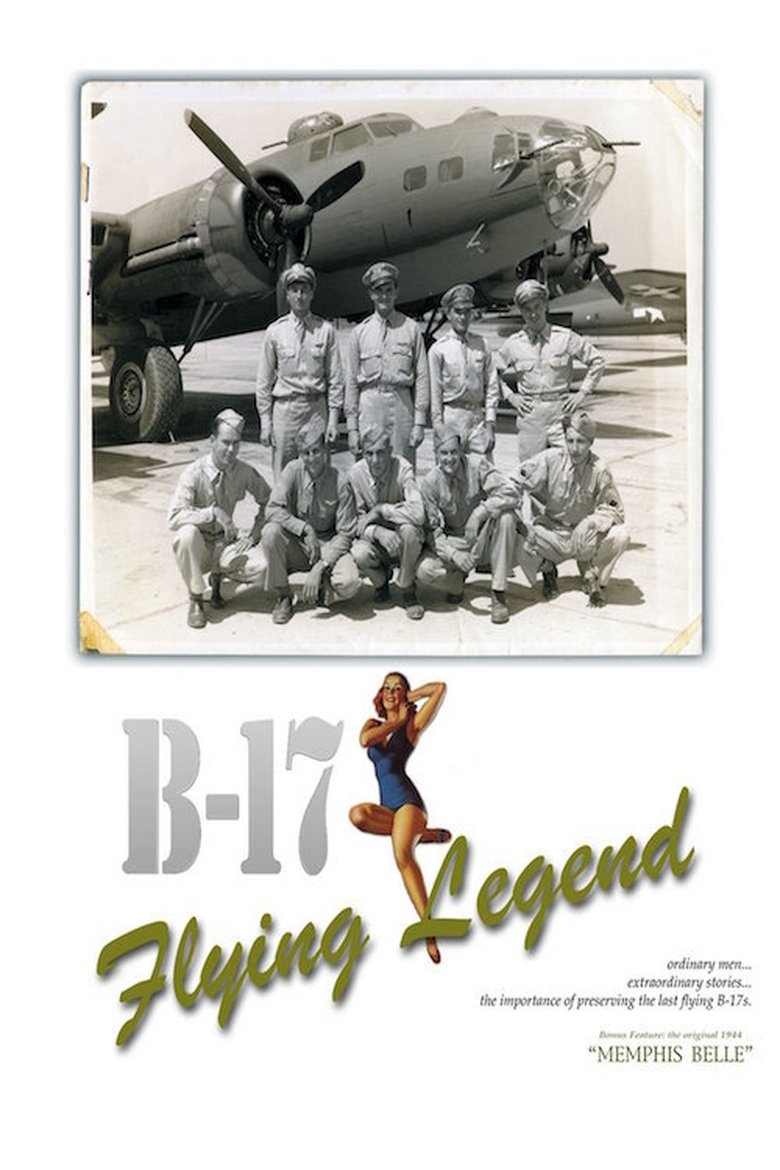
B-17 Flying Legend
Genres
Documentary
Overview
B-17 Flying Legend examines the importance of World War II's most famous airplane, and raises awareness about the importance of keeping the remaining B-17s flying for generations to come. This documentary covers the history of the airplane, from early designs to the outbreak of war, and the stories of bravery behind the faces of the men who flew them. It contrasts the past by also focusing on today's struggles to keep these flying museums in operation. Unless awareness is created to help with this preservation, in the near future B-17s will only be found in static displays. Almost 13,000 B-17s were built during the war. Sixty years later only 13 still fly. It is important to capture the history of the men behind these flying machines while they are still alive. It is also important to capture images of these machines while they still exist.
Details
Budget
$0
Revenue
$0
Runtime
53 min
Release Date
2007-06-01
Status
Released
Original Language
English
Vote Count
0
Vote Average
0
Cast
Meet the talented actors who bring the movie to life.
Similar Movies
Explore movies similar to this one that you might also enjoy.
6.7
Night Bombers
Recorded during World War II, this rare color film traces an RAF Bomber Command night attack on Berlin -- from strategic planning and preparation to the execution of the actual attack with Avro Lancaster bombers. Air Commodore H.I. Cozens filmed the events during a period when the Bomber Command flew into Germany nearly every night for a massive series of raids on key targets.
1981-01-01 | en
0.0
Thanks Girls and Goodbye
Documentary using archival footage, newsreels and contemporary interviews with women of the WW2 Australian Women's Land Army.
1988-09-22 | en
0.0
The Blitz: London's Longest Night
Details the German bombing of London the night of the 29th of December, in 1940.
2007-10-27 | en
8.0
Les enfants de Pétain
2024-12-31 | fr
6.8
Reunion
Live footage from concentration camps after the liberation, and the complex transport and lodging of masses of prisoners of war and other deported people back to their home countries, at the end of World War II. A 45min 35mm print also exists (shown at Cinémathèque française in 2023).
1946-01-02 | fr
0.0
As If It Were Yesterday
Documents the little-known heroism of the Belgian Resistance who, during the Nazi occupation, hid over 4,000 Jewish children, rescuing them from deportation and extermination, , often risking their own lives. Directed by Myriam Abramowicz and Esther Hoffenberg, children of parents who spent the war in hiding, the film inspired the creation of The Hidden Child, a world-wide network of hidden children, which, for three decades, has organized reunions of hidden children with the families who hid them in Belgium during WWII.
1980-09-07 | fr
0.0
Unsettled History: America, China, and the Doolittle Tokyo Raid
Doolittle's Raiders pull off a one-way bombing run over Tokyo and ditch their planes in and along the coast of China, where they are rescued by Chinese villagers, guerrillas, and missionaries. That generosity triggers horrific retaliation by the Japanese that claims an estimated quarter-million lives and prompts comparisons to the 1937-38 Rape of Nanking. The memory of the Raiders and their rescuers is kept alive by their children and grandchildren.
2022-04-18 | en
0.0
No Job For a Woman
Martha Gellhorn, Ruth Cowan, Dickey Chappelle: Three tenacious journalists who forged legendary reputations as war correspondents during a time when battlefields were considered no place for a woman. Their repeated delegation to the sidelines to cover the “woman’s angle” succeeded in expanding the focus of war coverage to bring home a new kind of story— a personal look at the human cost of war. Featuring an abundance of archival photos and interviews with modern female war correspondents, as well as actresses bringing to life the written words of these remarkable women.
2011-04-10 | en
7.4
The Last Days
Five Jewish Hungarians, now US citizens, tell their stories: before March 1944, when Nazis began to exterminate Hungarian Jews, months in concentration camps, and visiting childhood homes more than 50 years later. An historian, a Sonderkommando, a doctor who experimented on Auschwitz prisoners, and US soldiers who were part of the liberation in April 1945.
1998-10-23 | en
6.4
Why We Fight: Prelude to War
Prelude to War was the first film of Frank Capra's Why We Fight propaganda film series, commissioned by the Pentagon and George C. Marshall. It was made to convince American troops of the necessity of combating the Axis Powers during World War II. This film examines the differences between democratic and fascist states.
1942-05-27 | en
5.9
Report from the Aleutians
A documentary propaganda film produced by the U.S. Army Signal Corps about the Aleutian Islands Campaign during World War II. The film opens with a map showing the strategic importance of the island, and the thrust of the 1942 Japanese offensive into Midway and Dutch Harbor. Nominated for the Academy Award for Best Documentary Feature.
1943-07-30 | en
7.8
Guy Martin's D-Day Landing
Guy Martin undertakes a challenge to restore a plane from the Second World War, and recreate a parachute jump into Normandy, as thousands of Allied soldiers did during D-Day.
2019-06-02 | en
0.0
Rhin et Danube
A documentary produced by the French armed forces which chronicles the way of France’s “1ere armée” in the second world war from the days it first crossed the Rhine in March of 1945, through the liberation of a POW-camp in Swabia, until the forces reached the Danube and the Alps at the end of the war and the day French troops marched in the victory parade in Berlin.
1948-01-01 | en
7.8
Mein Kampf
"Mein Kampf" presents the raising and fall of the Third Reich, showing mainly the destruction of Poland and the life Hitler, which is told since he was a mediocre student and frustrated aspirant of artist living in slums in Austria and Germany, until his suicide in 1945 after being the responsible for the death of million of people, and the destruction of Europe. All the footage is real and belonged to a secret file of Goebbels, inclusive with many very strong scenes filmed by Goebbels himself.
1960-04-24 | sv
8.0
George Marshall and the American Century
He built the mightiest army in history and selected its leaders. Eisenhower, MacArthur and Patton all obeyed his commands. George Marshall was the only soldier ever to receive the Nobel Peace Prize.
1993-05-14 | en
0.0
Bosnia That Vanished
A collection of material shot before and during WW2 in the director’s hometown of Banja Luka, where its quiet life was disrupted by the enemy.
1944-01-01 | sh
7.6
Night Will Fall
When Allied forces liberated the Nazi concentration camps in 1944-45, their terrible discoveries were recorded by army and newsreel cameramen, revealing for the first time the full horror of what had happened. Making use of British, Soviet and American footage, the Ministry of Information’s Sidney Bernstein (later founder of Granada Television) aimed to create a documentary that would provide lasting, undeniable evidence of the Nazis’ unspeakable crimes. He commissioned a wealth of British talent, including editor Stewart McAllister, writer and future cabinet minister Richard Crossman – and, as treatment advisor, his friend Alfred Hitchcock. Yet, despite initial support from the British and US Governments, the film was shelved, and only now, 70 years on, has it been restored and completed by Imperial War Museums under its original title "German Concentration Camps Factual Survey".
2014-06-07 | en
0.0
Obliging Collaborators
The code to unlocking this feature documentary is 1949, the year the director was born, and also the year of the return of Soviet repressions to Latvia. The film tells a very personal story against the background of less visited historic events – the death of director’s father due to the KGB repressions, which is closely linked to the devious game Soviet Latvia’s KGB played against Swedish-British-American spy agencies.
2014-08-23 | lv
7.5
Comrades under Edelweiss
This rare documentary was filmed with the participation and personal camera of Wolfgang Gorther, a German military cinematographer of the 1st mining division, who participated in the legendary ascent of Elbrus on the night of August 21, 1942. From the beginning of the Second World War and the last international winter sports week in Garmisch-Partenkirchen follows the invasion of the German troops into the Soviet Union: Dnieper, Zaporozhy, Kharkov, Rostov-on-Don, Nogaean Steppe, Caucasus – fighting at 50 degrees below zero, military expedition into the world of ice and snow; – ascent of mountain arrows and subsequent hoisting of flags on the Elbrus at an altitude of 5,633 meters.
1943-01-02 | de
0.0
Sunset Boulevards
In this documentary about the exile of two famous French actors in Argentina during and after World War II, the director Cozarinsky returns to Argentina after many years in France and recalls places and events from his childhood, particularly the celebration of the liberation of Paris on in August of 1944, in Buenos Aires's Plaza Francia. Featuring testimony from various authors and acquaintances of Maria (Renee) Falconetti and Robert Le Vigan, the film explores their lives and final years in Argentina.
1992-08-01 | fr