Loading

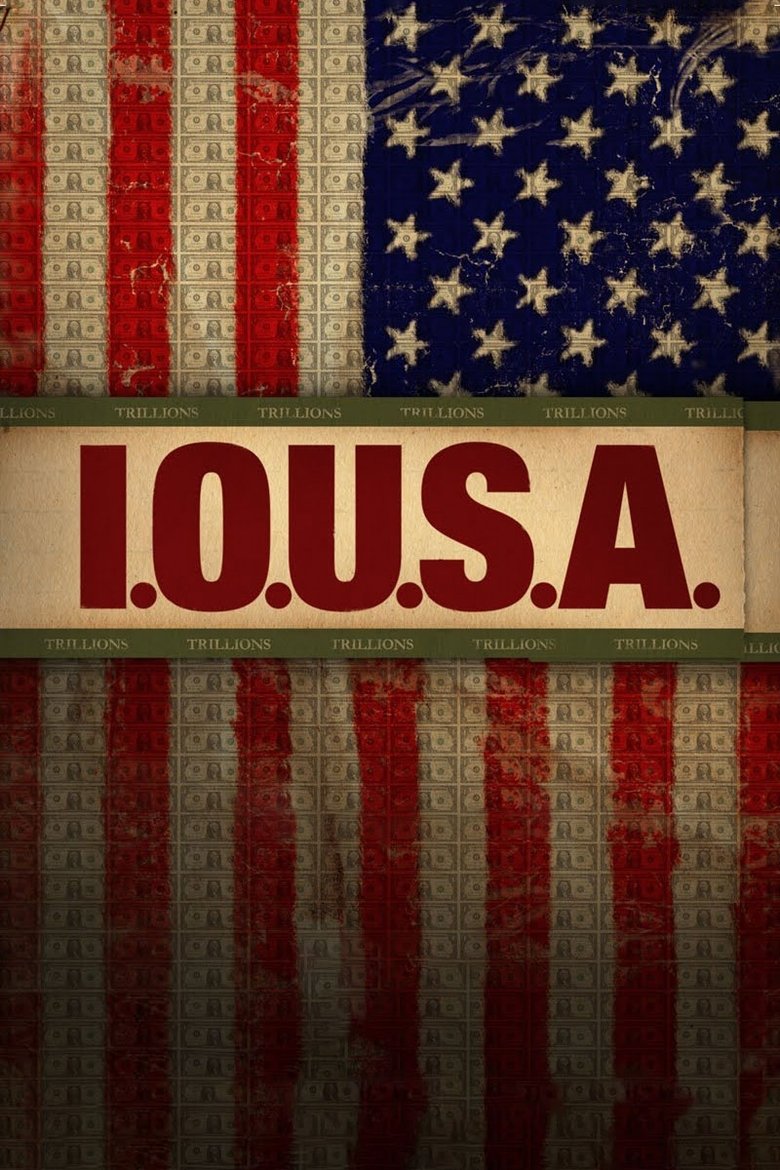
I.O.U.S.A.
Genres
Documentary
Overview
With the country's debt growing out of control, Americans by and large are unaware of the looming financial crisis. This documentary examines several of the ways America can get its economy back on the right track. In addition to looking at the federal deficit and trade deficit, the film also closely explores the challenges of funding national entitlement programs such as Social Security, Medicare and Medicaid.
Details
Budget
$0
Revenue
$0
Runtime
85 min
Release Date
2008-01-19
Status
Released
Original Language
English
Vote Count
37
Vote Average
6.932
Cast
Meet the talented actors who bring the movie to life.
Robert Bixby
Self
Warren Buffett
Self
Douglas Durst
Self
Alan Greenspan
Self
Judd Gregg
Self
Similar Movies
Explore movies similar to this one that you might also enjoy.
5.5
The Bubble
Diving deep into the true causes of the Great Recession, the financial crisis of the 2010s, renowned economists, investors and business leaders explain what America is facing if we don't learn from our past mistakes. Is the economy really improving or are we just blowing up another Bubble?
2018-07-12 | en
7.2
Enron: The Smartest Guys in the Room
A documentary about the Enron corporation, its faulty and corrupt business practices, and how they led to its fall.
2005-04-22 | en
7.6
The Corporation
Since the late 18th century American legal decision that the business corporation organizational model is legally a person, it has become a dominant economic, political and social force around the globe. This film takes an in-depth psychological examination of the organization model through various case studies. What the study illustrates is that in the its behaviour, this type of "person" typically acts like a dangerously destructive psychopath without conscience. Furthermore, we see the profound threat this psychopath has for our world and our future, but also how the people with courage, intelligence and determination can do to stop it.
2003-09-10 | en
0.0
Euroestafa
This documentary analyses the perverse monetary policies initiated before the euro inception. It focuses on the case of Spain and the terrible housing bobble that developed there.
2014-06-26 | es
9.0
Empire City
A film essay contrasting the modern metropolis with its "golden age" from 1830-1930, with the participation of some of New York's leading political and cultural figures. Made at a time when the city was experiencing unprecedented real estate development on the one hand and unforeseen displacement of population and deterioration on the other. Empire City is the story of two New Yorks. The film explores the precarious coexistence of the service-based midtown Manhattan corporate headquarters with the peripheral New York of undereducated minorities living in increasing alienation.
1985-07-01 | en
6.0
White Walls Say Nothing
Buenos Aires is a complex, chaotic city. It has European style and a Latin American heart. It has oscillated between dictatorship and democracy for over a century, and its citizens have faced brutal oppression and economic disaster. Throughout all this, successive generations of activists and artists have taken to the streets of this city to express themselves through art. This has given the walls a powerful and symbolic role: they have become the city’s voice. This tradition of expression in public space, of art and activism interweaving, has made the streets of Buenos Aires into a riot of colour and communication, giving the world a lesson in how to make resistance beautiful.
2017-05-02 | es
7.1
Roger & Me
A documentary about the closure of General Motors' plant at Flint, Michigan, which resulted in the loss of 30,000 jobs. Details the attempts of filmmaker Michael Moore to get an interview with GM CEO Roger Smith.
1989-09-01 | en
0.0
Loyalty Cards: Are They Worth It?
Alexis Conran investigates whether loyalty cards save consumers money when shopping, looking into the possibility that supermarkets could be inflating prices only to discount them. Alexis discovers how supermarkets offer a reduced price in return for an exchange of data from shoppers, speaking to those responsible for handling the data and making profits from it.
2024-01-10 | en
0.0
Freedom of Choice: How the Government Controls What You Consume
Life is about choice. What we eat, what we read, who we elect; every day we make choices that determine how we want to live. But what if these choices are just an illusion? In an era where regulations and red tape rule every industry, where lobby groups and big businesses wield more influence than ever before, our daily choices have become increasingly limited. And with all our options so deliberately handpicked, are we really making a choice at all? Freedom From Choice examines the current state of life and personal choice today. Experts from many different fields offer a frank and startling look at the hidden limitations in our daily lives. Focusing on key areas such as food, medicine, finance, and media, Freedom From Choice provides viewers with a glimpse at the myriad of ways their lives are being dictated and tells us who stands to gain.
| en
6.2
In Debt We Trust: America Before the Bubble Bursts
Emmy-winning journalist Danny Schechter investigates America's mounting debt crisis in this latest hard-hitting expose. The film reveals the unknown cabal of credit card companies, lobbyists, media conglomerates and the Bush administration itself who have colluded to deregulate the lending industry, ensuring that a culture of credit dependency can flourish. Schechter exposes the hidden financial and political complex that allows the lowest wage earners to indebt themselves so heavily that even house repossessions are commonplace.
2007-01-01 | en
0.0
Krach : sommes-nous prêts pour la prochaine crise ?
2020-02-25 | fr
3.0
What Makes Us Tick
An optimistic overview and explanation of the stock market with animated examples.
1952-01-01 | en
6.0
Debt
DEBT is the story of a frantic pursuit: the search for the responsible for the televised cry of hunger of Barbara Flores, an eight-year-old Argentinean girl. Buenos Aires, Washington, the IMF, the World Bank and Davos; corruption and the international bureaucratic lack of interest.
2004-10-07 | es
0.0
The Real Adam Smith: Ideas That Changed The World
The Real Adam Smith: A Personal Exploration by Johan Norberg, takes an intriguing, two-part look at Smith and the evolution and relevance of his ideas today, both economic and ethical. It’s difficult to imagine that a man who lived with horse drawn carriages and sailing ships would foresee our massive 21st century global market exchange, much less the relationship between markets and morality. But Adam Smith was no ordinary 18th century figure. Considered the “father of modern economics,” Smith was first and foremost a moral philosopher. The revolutionary ideas he penned in The Wealth of Nations and The Theory of Moral Sentiments, changed the world. Norberg explores Smith’s insights regarding free trade and the nature of wealth to the present, where they are thriving and driving the world’s economy.
| en
7.3
Money as Debt
Paul Grignon's 47-minute animated presentation of "Money as Debt" tells in very simple and effective graphic terms what money is and how it is being created
2006-01-01 | en
7.2
1929: The Great Crash
A documentary exploring the causes of the 1929 Wall Street Crash.Over six terrifying, desperate days in October 1929, shares crashed by a third on the New York Stock Exchange. More than $25 billion in individual wealth was lost. Later, three thousand banks failed, taking people's savings with them. Surviving eyewitnesses describe the biggest financial catastrophe in history.
2009-01-01 | en
8.2
On the Edge
Things are busy at the Paris hospital where young psychiatrist Jamal and his colleagues work. The place is run down, the staff are exhausted, budgets are constantly being slashed. You know the story, but you’ve rarely seen it conveyed as engagingly as in ‘On the Edge’, which employs a handheld camera and meaningful, artistic interventions to observe the daily routine at the psychiatric ward. The deeply sympathetic Jamal is an everyday hero with an exemplary, humanistic disposition, for whom the most important prerequisites for mental health – and for a healthy society in general – are good relationships with other people. He puts his philosophy into practice by listening patiently, giving good advice and organising theatre exercises based on Molière. Realism and idealism, however, are in balance for the young doctor, at least as long as the institutional framework holds up.
2023-03-18 | fr
7.9
The End of Poverty?
The End of Poverty? asks if the true causes of poverty today stem from a deliberate orchestration since colonial times which has evolved into our modern system whereby wealthy nations exploit the poor. People living and fighting against poverty answer condemning colonialism and its consequences; land grab, exploitation of natural resources, debt, free markets, demand for corporate profits and the evolution of an economic system in in which 25% of the world's population consumes 85% of its wealth. Featuring Nobel Prize winner Amartya Sen and Joseph Stiglitz, authors/activist Susan George, Eric Toussaint, Bolivian Vice President Alvaro Garcia Linera and more.
2008-05-19 | en
6.3
The Secret of Oz
It is well known in economics academia that The Wonderful Wizard of Oz written by L. Frank Baum in 1900 is loaded with powerful symbols of monetary reform which were the core of the Populist movement and the 1896 and 1900 president bid of Democrat William Jennings Bryan. The yellow brick road (gold standard), the emerald city of Oz (greenback money), even Dorothy’s silver slippers (changed to ruby slippers for the movie version) were the symbol of Baum’s and Bryan’s belief that adding silver coinage to gold would provide much needed money to a depression-strapped, 1890s America. We believe Baum’s symbols represent the only solution to relieve the growing economic hardship here in America – and the rest of the world. Practically speaking, 2009 marks the 70th anniversary of the 1939 MGM release of the The Wizard of Oz movie, so interest will be very high. Even Oz websites put up by kids get millions of hits.
2009-10-01 | en
6.2
Wal-Mart: The High Cost of Low Price
This documentary takes the viewer on a deeply personal journey into the everyday lives of families struggling to fight Goliath. From a family business owner in the Midwest to a preacher in California, from workers in Florida to a poet in Mexico, dozens of film crews on three continents bring the intensely personal stories of an assault on families and American values.
2005-11-04 | en