Loading

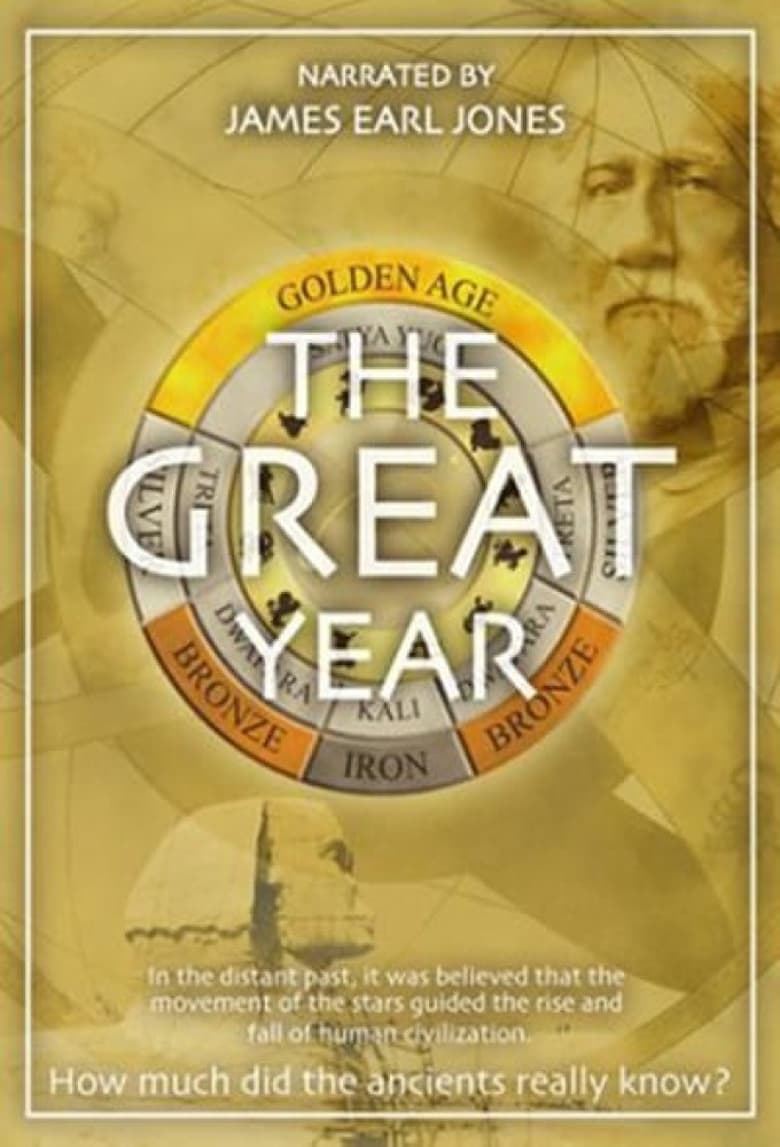
The Great Year
How much did the ancients really know?
Genres
Documentary
Overview
The Great Year is a compelling documentary that explores the possibility that the fall of ancient civilizations around the globe, and the rise of modern civilization, might be related to our Sun’s motion around a companion star. The film examines evidence that ancient civilizations may have known of this celestial cycle and that our Sun may indeed display the characteristics of binary motion. Just as the Earth’s spin on its axis causes day and night and our planet’s annual orbit around the Sun is responsible for the ongoing cycle of the seasons, what if there is some greater celestial cycle, lasting thousands of years, slowly influencing the rise and fall of civilization across the globe? Where is the evidence? What could be the cause?
Details
Budget
$0
Revenue
$0
Runtime
46 min
Release Date
2003-08-01
Status
Released
Original Language
English
Vote Count
2
Vote Average
9
Cast
Meet the talented actors who bring the movie to life.
James Earl Jones
Narrator
Walter Cruttenden
Himself
John Anthony West
Himself
Uwe Homann
Himself
Werner Däppen
Himself
Brother Achalananda
Himself
Ronald J. Mellor
Himself
Similar Movies
Explore movies similar to this one that you might also enjoy.
6.4
King Tut In Color
The discovery of Tutankhamun’s tomb is revealed for the first time in color, thanks to colorization of black-and-white newsreel and photographs.
2021-09-27 | en
0.0
Zero Gravity: Life on the International Space Station
European Space Agency astronaut Alexander Gerst and his NASA colleague Reid Wiseman are launched into space from the Baikonur Cosmodrome in Kazakhstan. Gerst and Wiseman spend six months in humanity's outpost in space and film many of their activities.
2022-01-01 | en
0.0
The Lost Pharaoh: The Search for Akhenaten
Ancient pharaoh Akhenaten was almost lost to history. Canadian archaeologist Donald Redford, who uncovered the foundation of one of the pharaoh’s many temples, attempts to finally piece together this great Egyptian ruler’s enigmatic story.
1980-11-30 | en
6.0
Venus: Death of a Planet
Billions of years ago, Venus may have harbored life-giving habitats similar to those on the early Earth. Today, Earth's twin is a planet knocked upside down and turned inside out. Its burned-out surface is a global fossil of volcanic destruction, shrouded in a dense, toxic atmosphere. Scientists are now unveiling daring new strategies to search for clues from a time when the planet was alive.
2021-08-28 | en
7.2
Searching for Planet 9
At the edge of our solar system supposedly lies an immense planet. Five to ten times the size of the Earth. Several international teams of scientists have been competing in a frantic race to detect it, in uncharted territories, far beyond Neptune. The recent discovery of several dwarf planets, with intriguing trajectories, have put astronomers on the trail of this mysterious planet. Why is this enigmatic planet so difficult to detect? What would a ninth planet teach us about our corner of the universe? Could it help us unlock some of the mysteries of our solar system?
2022-09-17 | fr
7.0
The Lost Tomb of Alexander the Great
In this gripping investigation, archaeologist Pepi Papakosta is on a hunt for Alexander the Great's lost tomb, and she makes an extraordinary discovery.
2019-03-04 | en
7.6
Caligula with Mary Beard
What is true and what is false in the hideous stories spread about the controversial figure of the Roman emperor Gaius Julius Caesar Augustus Germanicus (12-41), nicknamed Caligula? Professor Mary Beard explains what is accurate and what is mythical in the historical accounts that portray him as an unbalanced despot. Was he a sadistic tyrant, as Roman historians have told, or perhaps the truth about him was manipulated because of political interests?
2013-07-29 | en
6.9
Cielo
The first feature from Alison McAlpine is a dialogue with the heavens—in this case, the heavens above the Andes and the Atacama Desert in northern Chile, where she alights on the desert- and mountain-dwelling astronomers, fishermen, miners, and cowboys who live their lives with reverence and awe for the skies.
2017-10-06 | en
4.3
The First Emperor of China
This historical drama tells the story of Qin Shihuang, who unified China's vast territory and declared himself emperor in 221 B.C. During his reign, he introduced sweeping reforms, built a vast network of roads and connected the Great Wall of China. From the grandiose inner sanctum of Emperor Qin's royal palace, to fierce battles with feudal kings, this film re-creates the glory and the terror of the Qin Dynasty, including footage of Qin's life-sized terra cotta army, constructed 2,200 years ago for his tomb.
1989-01-01 | en
6.2
The Hunt for Dark Matter
CERN and the University of California-Santa Barbara are collaborating in the search for the elusive substance that physicists and astronomers believe holds the universe together -- dark matter. Where is this search now in the realm of particle physics and what comes next?
2017-05-04 | en
0.0
Shadow Chasers
This feature-length documentary is a portrait of eclipse chasers, people for whom solar eclipses - among nature's more spectacular phenomena – are a veritable obsession. The film follows 4 of them as they travel incredible distances to witness the last total eclipse of the millennium as it sweeps eastward across Europe to India. At various points along the way enthusiasts Alain Cirou in France, Paul Houde in Austria, Olivier Staiger in Germany and Debasis Sarkar in India offer their impressions of the historic event.
2000-09-23 | fr
7.7
Die Sonne
The sun is the miracle that makes everything possible - but also the greatest danger. For the first time, a feature-length documentary is dedicated to the search for the significance of our home star for mankind, science and nature. Thanks to the researchers from the American space agency NASA, who work at the Canary Islands observatories in the hottest and coldest places on the planet.
2024-02-10 | de
8.0
The Mystery of Chaco Canyon
Chaco Canyon, located in northwest New Mexico, is perhaps the only site in the world constructed in an elaborate pattern that mirrors the yearly cycle of the sun and the 19-year cycle of the moon. How did an ancient civilization, with no known written language, arrange its buildings into a virtual celestial calendar, spanning an area roughly the size of Ireland?
1999-01-01 | en
10.0
Prehistoric Astronomers
Cave paintings and lunar calendars exist in the caves and remains of prehistoric hunters studied recently. What if Prehistoric Man were clever enough to develop in depth scientific knowledge? As unlikely as it may seem, new data tend to prove that Prehistoric Man actually invented Astronomy!
2007-01-01 | en
0.0
Living Worlds
What forms might life take in the Solar System and beyond? In the Academy's newest original planetarium show, see how a deeper understanding of Earth might help us locate other living worlds, light years away.
2021-11-01 | en
0.0
The Whisper of Ziggurat: Untold Secrets of Elamite Civilization
5000 years ago the ancient Elamites established a glorious civilization that lasted about three millennia. They created marvelous works in architecture and craftsmanship. These works of art depict the lifestyle, thoughts, and beliefs of the Elamites.
2020-10-26 | en
0.0
The Once and Future Griffith Observatory
Documentary about the Griffith Observatory, shown at their Leonard Nimoy Event Horizon Theater
2006-05-31 | en
10.0
The Tomb of the Scythian Prince
The Scythians, skilled horsemen and nomadic conquerors, built a feared empire in the vast Eurasian steppe between the 9th and 3rd centuries B.C. All that remains are their graves: the Kourganes. In April 1999, a 2400 year-old Scythian tomb was discovered in Kazakhstan. It contained, among other treasures, twelve horses completely harnessed in gold, suggesting high social status.
2000-11-13 | fr
6.7
Pompeii: Secrets of the Dead
Forensic experts scan Pompeii’s victims to investigate why they didn’t escape the eruption.
2019-11-24 | en
0.0
The Hunt for Cleopatra's Tomb
Dr Glenn Godenho goes on the hunt for the tomb of Cleopatra.
2020-06-04 | en