Loading

The Dark Glow of the Mountain
Genres
Documentary
Overview
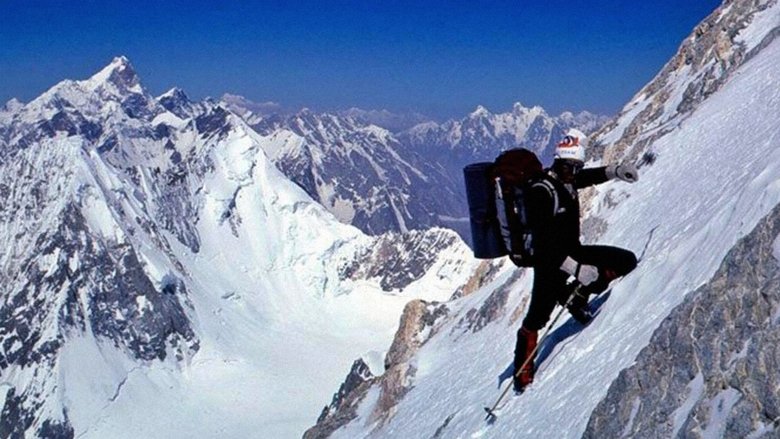
Werner Herzog follows mountaineers Hans Kammerlander and Reinhold Messner during their expedition into climbing the Gasherbrum mountains, which has some of the most difficult peaks to be conquered, and they'll do it without the use of oxygen tanks. Herzog also takes some time to hear about their past experiences with other mountains, their personal tragedies and the reasons why they are so involved with such activity.
Details
Budget
$62500
Revenue
$0
Runtime
45 min
Release Date
1985-03-09
Status
Released
Original Language
German
Vote Count
28
Vote Average
7.6
Cast
Meet the talented actors who bring the movie to life.
Werner Herzog
Self (voice)
Reinhold Messner
Self
Hans Kammerlander
Self
Similar Movies
Explore movies similar to this one that you might also enjoy.
9.0
Pico Sacro [The Holy Mountain]
In a leafy forest, a Galician sovereign who longs to attain wisdom meets a sorcerer, who tells him: “Go back to your country and study the Earth and the Stars in the sky; anywhere in the world reflects an image of it. You will ride on this arrow, which you must keep for a hundred years and a day. After this time, stick it in the widest valley of all those you possess, with the tip facing the sky. Then the Moon will come and, just as it exerts its action on the waters of the sea, it will act on the arrow, turning it into a holy mountain." - Legend about the Pico Sacro Inspired by Hokusai's views of Mount Fuji and Cézanne's paintings of Mont Sainte-Victoire, "Pico Sacro [The Holy Mountain]" aims to reveal the mystery and the magic that underlie reality.
2024-11-11 | gl
6.6
Stars at Noon
Les Etoiles de Midi is an engaging docudrama about some of the more spectacular exploits of French mountain climbers over the last several decades. In one re-enacted story, there is a wartime escape through the mountains, and in another, a daring rescue of a pair of climbers who had been missing. The actors themselves are adept at the sport of climbing, and they give the scenes an immediacy and real daring that brings the stories alive. A combination of their acrobatics and skill and the outstanding episodes in the history of French climbing creates a winning 78 minutes.
1959-01-01 | fr
0.0
In the Shadow of Karakorum
In 1954, a German-Austrian expedition led by Mathias Rebitsch set off for the difficult-to-access Karakoram Mountains, geographically north of the Himalayas. They come across the Hunza, a people who live in the valley of the same name and believe they are descended from the soldiers of Alexander the Great. The documentary conveys impressions of the poor life of the Hunza people, the harvest, a court hearing, festivals and the children's everyday school life. Finally, the expedition sets off again and sets up its main camp on the moraine ridge of a glacier, where they measure the glacier and the earth's magnetic field. Finally, some men from the research community set off for a sub-peak of Batura.
1955-08-03 | de
0.0
He Toki Huna: New Zealand in Afghanistan
Annie Goldson and Kay Ellmers’ doco, expanded from the film they made for Maori Television, takes a timely look at New Zealand’s military and media, notably journalist Jon Stephenson, in Afghanistan.
2013-08-04 | en
0.0
Dans les pas du Groupe
2019-10-08 | fr
10.0
Sahara - From Void To Rock
Sahara - Hutsetik Haitzera is a mountain documentary about the climbing of Tizouyag Nord in the Hoggar Desert in Algeria by the Spanish Basque team composed of Alberto Iñurrategi, Jon Lazkano, Juanjo San Sebastián, Jon Beloki and Asier Aranguren. Made by climber Alberto Iñurrategi in 2002 and produced by Iñurrategi Anaiak, it is part of the Oinak Izarretan series.
2002-01-01 | eu
10.0
Cervin 1865, une première tragique
The first ascent of the Matterhorn was made on July 14, 1865 by Edward Whymper, Francis Douglas, Charles Hudson, Douglas Hadow, Michel Croz and two guides from Zermatt, Peter Taugwalder father and son. Douglas, Hudson, Hadow and Croz are killed on the descent after Hadow slips and drags the other three men down the north face. Whymper and the two Taugwalders, who survive, are later accused of having cut the rope that connected them to the rest of the group so as not to be dragged into the fall, but the ensuing investigation finds no evidence of their guilt and they are acquitted. The Matterhorn is the last great peak in the Alps to be conquered and its ascent marks the end of the golden age of mountaineering. One hundred and fifty years later, a team undertakes the same expedition in order to unravel the mystery.
2015-03-26 | de
8.0
Rotpunkt
Rotpunkt documents the advent, the agony and the art of the redpoint through Alex Megos’s efforts to redefine the boundaries of the form. The film traces the redpoint—which transformed rock climbing from an engineering problem into a brilliant test of mental and physical strength—from its origins with a ragtag bunch of tights-wearing revolutionaries in rural Bavaria, to its golden era with Wolfgang Güllich, to its new ideal in the German phenom Megos as he battles to unlock new levels of human potential.
2019-11-18 | en
0.0
Amir: An Afghan Refugee Musician's Life in Peshawar, Pakistan
Amir, shot during the height of the Afghan civil war in the 1980s, investigates and portrays the life of Afghan refugees living in and around the city of Peshawar in northern Pakistan through the experiences of the musician Amir. The aspirations of Afghan refugees are expressed through their political songs dealing with the civil war in Afghanistan, with exile, with Afghan nationalism and with the Islamic revolution. In highly charged and tragic circumstances, music can be used in very direct ways, both to promote solidarity and as an agent of catharsis.
1985-01-01 | en
10.0
Aventure à Bleau
Adventure in Bleau is a documentary about bouldering that takes place in Fontainebleau. Directed by Jean-Paul Janssen in 1980 and produced by Antenne 2, it is part of the series "Les Carnets de l'Aventure" and broadcast on the same television channel. It features different generations of the finest free climbing artists of the time: Patrick Edlinger, Catherine Destivelle, Lucien Bérardini, Jean Pierre Bouvier, and Bertrand Roche 'Zébulon'.
1980-01-01 | fr
10.0
Generation Dry
It is a fact that our winters are less and less cold. Therefore it is harder and harder to get the conditions for ice-climbing. Fortunately, man adapts to his environment and makes progress: this is how dry-tooling was born. This movie will make you discover this discipline: its history, its evolution and the current practice. You will also see how much excitement dry tooling can bring. Dry-tooling now allows to free-climb some routes which were impossible to climb without aid in the past.
2016-01-01 | fr
10.0
Nanda Devi
In 1975, Raymond Renaud, Yves Pollet-Villard, Maurice Gicquel, Maurice Cretton, Jean Coudray, Yvon Masino, Walter Cecchinel, all teacher guides at ENSA in Chamonix, with the help of the Indian Mountaineering Foundation, set out to cross the 2 peaks of the highest mountain in India. After 43 hours in a truck, 10 days of slow and difficult approach walking, helped by goats for the portage due to lack of sherpas, the base camp is set up on the Nanda Devi glacier. Two groups share the two eastern and western slopes, 3 kilometers separate them: the goal being to meet between the two summits by the ridge. But on the big day, with the monsoon, bad weather arrives with wind and snow, we will have to give up. Like the French expedition of 1951 which lost two mountaineers, Roger Duplat and Gilbert Vigne, to whom Paul Gendre and Louis Dubosc pay tribute.
1975-01-01 | fr
6.9
Taxi to the Dark Side
An in-depth look at the torture practices of the United States in Afghanistan, Iraq and Guantanamo Bay, focusing on an innocent taxi driver in Afghanistan who was tortured and killed in 2002.
2008-01-18 | en
0.0
Draw
2006-08-15 | en
5.0
Rhod Gilbert vs Kilimanjaro
In 2013 Velindre Cancer Care asked Rhod to lead an expedition to climb Kilimanjaro, the 19,341 ft high volcano in Africa. Rhod assumed they were 'taking the piss' but gave it a go anyway. He got together with some friends and tried to get fit before setting off for the peak.
2014-12-09 | en
5.5
Sidik and the Panther
If Sidik manages to spot a leopard in his beloved mountains of Kurdistan, the area can be declared a protected nature reserve. Will that finally bring peace?
2019-04-16 | ku
0.0
Sulle orme del K2
2025-01-02 | it
10.0
The Ravier Brothers - The Pyrenees Adventure
The two brothers Jean and Pierre Ravier have opened almost all the "classic" (difficult) routes in climbing and mountaineering in the Pyrenees. Roped together at the waist using a few flat knots and little equipment, the two twin brothers achieved more than 200 firsts across the entire massif. A unique style and commitment, a state of mind made up of adventure, literature, inventiveness and friendship. Unclassifiable and outgoing, after 60 years of Pyrenees, their desire for the mountains is intact. When does a race start? How does the idea, the desire, come about? What sense does it make to only achieve firsts? And what is the role of the Pyrenees themselves in this reciprocal and endless game of attraction?
2008-11-22 | fr
10.0
La République nous appelle
The story of the ascent of the Aiguille de la République by mountaineers Jacques Fromentin and Michel Bastien. The Aiguille de la République, in the Mont-Blanc massif, culminates at an altitude of 3,305 meters among the Aiguilles de Chamonix group of summits. In the Fontainebleau forest, children learn mountaineering techniques on the bouldering climbing site. In 1954, rock climbing was also practiced in the Chamonix valley. The Montenvers train crosses the viaduct taking tourists or athletes to the Mer de Glace viewpoint. The two climbers take an approach step and reach the Envers des Aiguilles refuge. They then climb this steep and smooth wall, progressing along the ridge. On the platform, a rope throw allows them to climb up and sit at the top to dominate the panorama. Then the return: abseiling from the summit block.
1954-01-01 | fr
10.0
Jannu, Chronicle of a Conquest
Three years after the 1959 expedition, abandoned 350m from the summit, Lionel Terray leads a new assault on Jannu, one of the most demanding peaks in the Himalayas. At the base camp, equipment and food rations are prepared. The conditions are optimal and the ascent can begin. The camera follows the progress of the mountaineers and Sherpas as closely as possible, from one high-altitude camp to another: installing fixed ropes, progressing over crevasses, in the middle of frozen towers, vertically down immense ice falls or along the edge of sharp ridges. From 7000m, oxygen bottles become essential, as the difficulty of the climb prevents acclimatization. The expedition is a total success: the majority of its members reach the 7710m summit.
1962-01-01 | fr