Loading

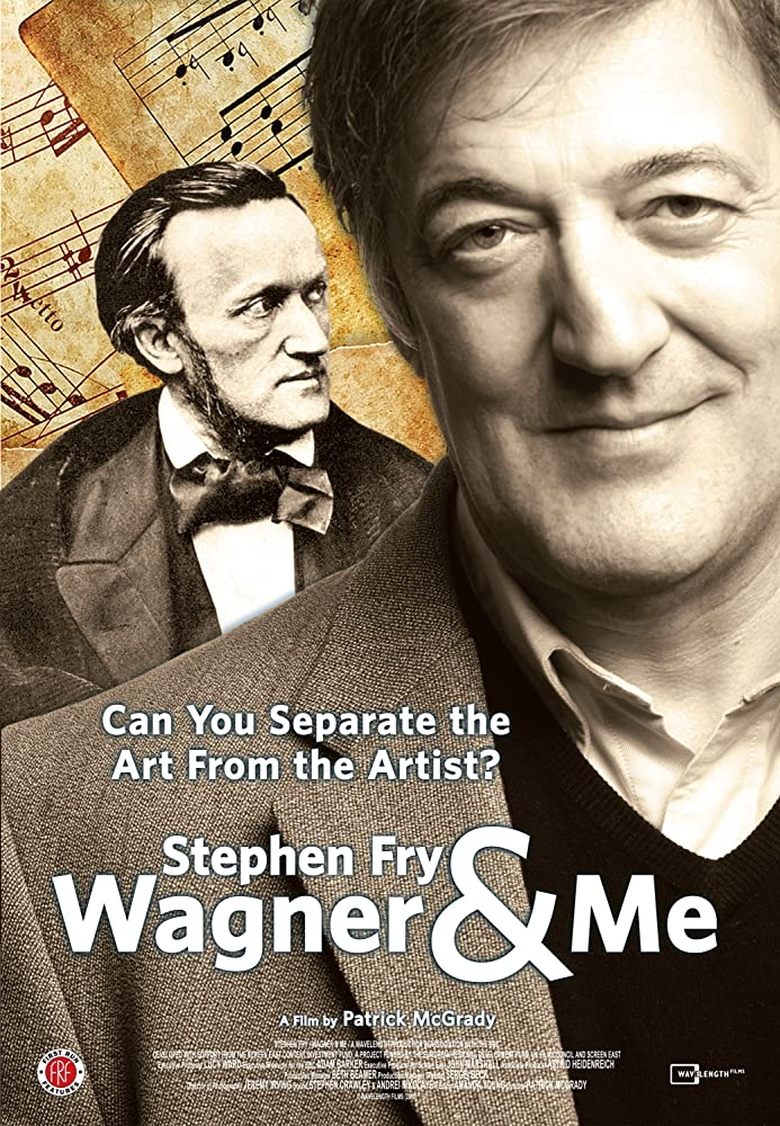
Wagner & Me
Genres
MusicDocumentary
Overview
Actor and writer Stephen Fry explores his passion for the world's most controversial composer, Richard Wagner. As a life-long fan can Stephen, who is Jewish and lost family in the Holocaust, salvage Wagner's music from its dark associations with anti-Semitism and Hitler?
Details
Budget
$0
Revenue
$0
Runtime
89 min
Release Date
2012-11-02
Status
Released
Original Language
English
Vote Count
7
Vote Average
6.7
Cast
Meet the talented actors who bring the movie to life.
Stephen Fry
Self
Similar Movies
Explore movies similar to this one that you might also enjoy.
0.0
Beethoven Piano Sonatas Vol. 1
2015-11-27 | en
0.0
Beethoven Piano Sonatas Vol. 2
2016-01-29 | en
0.0
Beethoven Piano Sonatas Vol. 3
2016-02-26 | en
0.0
Beethoven: Piano Concertos 1-5 - Uchida, Rattle
There is hardly a better way to approach Ludwig van Beethoven than through his piano concertos. Beethoven’s own instrument was the piano, and in his improvisations – which made him the darling of the Viennese salons – he merged virtuosity and unbridled expression. The piano concertos give a clear idea of these performances. At the same time, they are prime examples of Beethoven’s ability to create large orchestral works with seemingly endless arcs of tension. The complete recording of all five works with Mitsuko Uchida and Sir Simon Rattle was one of the most spectacular projects of the Berliner Philharmoniker during the Rattle era – and at the same time the highlight of the collaboration between the orchestra and the pianist, which began in 1984.
2018-12-07 | en
2.7
Pyaar Ka Saaya
Uncredited remake of "Ghost". Dead man's spirit, unable to bear separation from his wife, communicates to her through a wacky medium.
1991-11-29 | hi
8.0
Waldbühne 2017 | Legends of the Rhine
For their annual season end concert, the Berliner Philharmoniker take the audience on a dreamy, magically journey through the river Rhine with Schumann’s beloved 3rd Symphony Rhenish. Pieces from Wagner’s Der Ring des Nibelungen under the baton of dynamic conductor Gustavo Dudamel complete this evening.
2017-10-20 | de
0.0
André Rieu - The Christmas I Love
The Christmas I Love’ is a very special Christmas gift – a collection of some of the most tender carols personally chosen by Andre for this album and performed with the full forces of the Johann Strauss Orchestra and Choir. All the popular carols are there Ave Maria, White Christmas, Silent Night, Jingle Bells but also included are Baroque Christmas Classics Corelli's Christmas Concerto and “Winter” from Vivaldi's Four Seasons. The DVD offers a delightful Christmas experience featuring timeless yuletide favorites filmed in many of Europe's most beautiful locations.
2011-11-25 | nl
0.0
Europakonzert 2008 from Moscow
The Berliner Philharmoniker’s European Concert, held each year on 1 May, is invariably an international highlight. Performing in 2008 in Moscow's renowned Tchaikovsky Conservatory, the orchestra under Sir Simon Rattle presented outstanding performances of works by Beethoven, Stravinsky and Bruch, whose Violin Concerto featured one of today’s most fascinating artists, the Russian violinist Vadim Repin. Stravinsky: Symphony in Three Movements Bruch: Concerto for Violin No.1, op.26 Beethoven: Symphony No.7 in A major, op. 92
2008-05-01 | de
0.0
Bruckner: Symphony No. 7
In Anton Bruckner’s 7th Symphony, the listener encounters a music characterized by great spaciousness and profound solemnity, a music which speaks of grief and lamentation, but also of their transcendence. With its monumental architecture and intensity of sound, the symphony has moved listeners ever since its triumphal premiere in 1884. The Guardian calls Daniel Barenboim’s London interpretation “Tremendous … Barenboim and the Staatskapelle seem to have this work in their systems, and the overall impression was of music unfolding organically at its own pace rather than of a work being self-consciously interpreted or led.” Anton Bruckner Symphony No. 7 in E major (original version) Daniel Barenboim, conductor Staatskapelle Berlin Recorded live at the Philharmonie Berlin, 25 June 2010
2014-03-31 | en
0.0
Bruckner: Symphony No. 6
Anton Bruckner’s 6th Symphony was written between 1879 and 1881: a very happy time in his life. Unlike most of Bruckner’s symphonies, the 6th was not revised. Of all his works, this one seems to come from a single source of inspiration. Bruckner himself called it his “boldest” symphony – probably due to its extreme degree of motivic, rhythmic and harmonic originality. This live recording of the seldom-performed 6th Symphony is the next instalment of the acclaimed Bruckner cycle by the Staatskapelle Berlin and Daniel Barenboim. Anton Bruckner Symphony No. 6 in A major (original version) Daniel Barenboim, Conductor Staatskapelle Berlin Recorded live at the Philharmonie Berlin, 22 June 2010
2014-01-06 | en
0.0
Bruckner: Symphony No. 8
“Clarity was one thing that made this performance a marvel. Another was the flexibility of Barenboim’s speeds…. The flexibility of Barenboim’s tempi meant that Bruckner’s charm – an often overlooked aspect of his genius – shone through, especially in the genial Trio.” (The Telegraph) Bruckner’s 8th is the last symphony completed by the Austrian composer. Many of his contemporaries regarded the symphony as “the pinnacle of 19th century music”. Even today, this monumental work fascinates listeners with its virtuoso orchestral technique, its immensity of sound, and its inexhaustible richness of detail. Symphony No. 8 in C minor (second version 1887-90, Robert Haas Edition) Daniel Barenboim, Conductor Staatskapelle Berlin Recorded live at the Philharmonie Berlin, 26 June 2010
2014-11-03 | en
0.0
Grigory Sokolov - Live at the Berlin Philharmonie - Schubert & Beethoven
"Probably the best living pianist" headlined the Berliner Morgenpost's review of Grigory Sokolov's sold-out June 2013 recital at the Berlin Philharmonie. "The four Impromptus could no be interpreted more dramatically... The D 946 Pieces cried out with despair an longing for death." (from DVD cover)
2016-04-01 | en
10.0
Hinterkaifeck - Die wahre Geschichte hinter Tannöd
Still today, people say that during the stormy night from March 31st to April 1st, 1922, the devil had come to Hinterkaifeck. On the farmstead near Schrobenhausen, all 6 inhabitants – 4 Adults and two children – are struck down bestially. The police did not manage to seek out the murderer(s). As the case is still unsolved as of today, the story still lives on in the minds of the people. Motion pictures, theatre plays, and the bestselling novel “Tannöd”, behind all of them stands Hinterkaifeck. Aspiring police investigators and a self-declared “Internet – special commission ‘Hinterkaifeck’” have now once again taken up the trail of the case. This exciting search for traces is followed by the film, and its findings are recreated in elaborate play scenes. Thereby, a picture of an era thought to be bygone and an idea of what really happened back then comes into existence. More precise than any fiction, the docudrama manages to get closer to the truth.
2009-11-18 | de
6.7
Workers Leaving the Lumière Factory
Working men and women leave through the main gate of the Lumière factory in Lyon, France. Filmed on 22 March 1895, it is often referred to as the first real motion picture ever made, although Louis Le Prince's 1888 Roundhay Garden Scene pre-dated it by seven years. Three separate versions of this film exist, which differ from one another in numerous ways. The first version features a carriage drawn by one horse, while in the second version the carriage is drawn by two horses, and there is no carriage at all in the third version. The clothing style is also different between the three versions, demonstrating the different seasons in which each was filmed. This film was made in the 35 mm format with an aspect ratio of 1.33:1, and at a speed of 16 frames per second. At that rate, the 17 meters of film length provided a duration of 46 seconds, holding a total of 800 frames.
1895-03-22 | fr
10.0
30 Years of Argentine Rock
Aided by archival footage and interviews with its key figures, this documentary delves into the history of Argentine rock music from its origins up to the mid-1990s.
2020-05-17 | es
0.0
CODA
This short animation draws on advanced digital technologies to offer a new vision of dance in cinema. With motion capture (MoCap) and particle processing, designers Denis Poulin and Martine Époque create virtual dancers free of their morphological appearance. In this balletic and hypnotic film, dynamic traces carry the motion of the real dancers behind the on-screen movements. Addressing environmental themes by way of metaphor, CODA is a fused universe where space and time collide, deploy, and dissolve. In this technically and formally innovative film, luminous bodies in the infinite space of the cosmos transform and evolve to the rhythms of Stravinsky’s Rite of Spring.
2014-01-01 | en
0.0
André Rieu - Power of Love
Enjoy the summer evening concerts of André Rieu on the most romantic square in the Netherlands: the Vrijthof in Maastricht! You can use the options below to book your André Rieu Travel package, including concert tickets, as preferred.
2024-02-01 | en
0.0
Leonard Bernstein: The Gift of Music
Leonard Bernstein narrated by legendary screen star Lauren Bacall. The movie also relies extensively on Bernstein's own words to provide the counterpoint to the abundant visual material. Highlights include excerpts of Bernstein conducting masterworks by Beethoven and Mahler, as well as of the maestro with the New York Philharmonic in Moscow in 1959 before an audience which included composer Dmitri Shostakovich and the dissident poet Boris Pasternak. It also contains never-before-seen footage, such as outtakes from televised concerts and interviews. Among these special treats: the dashing 28-year-old maestro representing the U.S. at the 1947 Prague Spring Festival – possibly the earliest extant film of Leonard Bernstein.
| en
0.0
John Adams: The Gospel According to the Other Mary
Sir Simon Rattle, the Berliner Philharmoniker and the Rundfunkchor Berlin give an impeccable performance of the powerful biblical oratorio “The Gospel According to the Other Mary” by John Adams, one of the most renowned contemporary composers. The sophisticated score with a libretto by acclaimed theatre director Peter Sellars comes to life thanks to the Berliner Philharmoniker, whose intimate knowledge of Adams’s music stems from the composer himself: He attended the orchestra’s rehearsals. In the role of the Evangelist, Bubeck, Cummings and Medley lead through the narrative. A stunning highlight is Lazarus’s aria, sung by tenor Peter Hoare. But at the heart of the piece are Mary Magdalene and her sister Martha during the last days before Jesus’s death, impressively performed by mezzo-sopranos Kelley O’Connor and Tamara Mumford.
2017-01-28 | en
0.0
The Blues Brothers: Transposing The Music
A look at Dan and John's partnership and the music
2005-08-30 | en