Loading
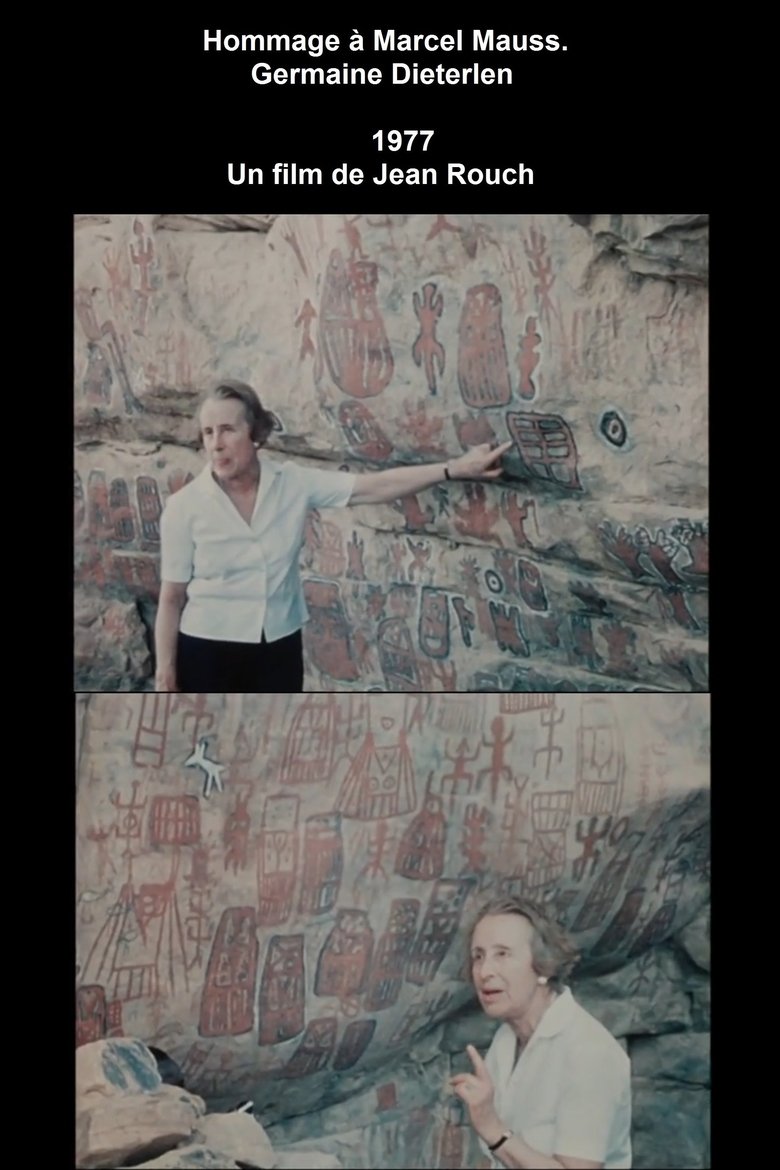
Hommage à Marcel Mauss. Germaine Dieterlen
Genres
Documentary
Overview
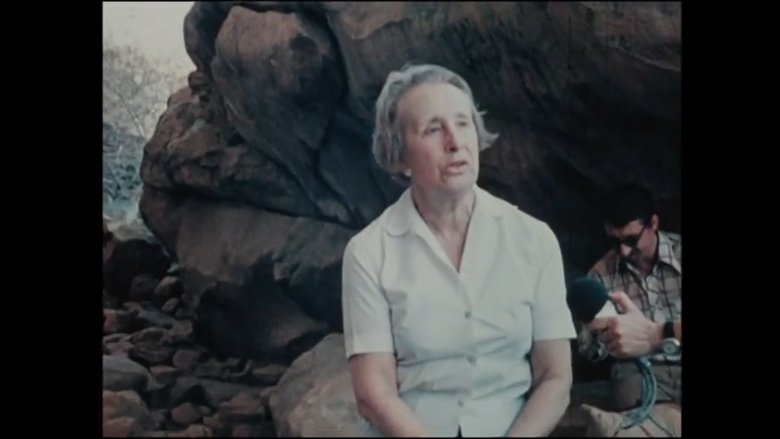
Germaine Dierterlen talks about Dogon mythology at a conference on the Bandiagara cliffs. The Songo canopy is a sacred site in Bandiagara. Its walls are covered with paintings depicting the different phases of creation. A little further on, in a cave near the village of Bongo, symposium participants are discussing the Tellem, the people who lived in the houses built into the cliffs before the arrival of the Dogon. The archaeological remains and migratory movements of these two peoples are discussed.
Details
Budget
$0
Revenue
$0
Runtime
27 min
Release Date
1977-01-01
Status
Released
Original Language
French
Vote Count
0
Vote Average
0
Cast
Meet the talented actors who bring the movie to life.
Germaine Dieterlen
herself
Similar Movies
Explore movies similar to this one that you might also enjoy.
8.0
The Bounty Hunter of Mongolia
In the Darhat valley in northern Mongolia, the horses of nomadic tribes are stolen by bandits who then sell them to Russian slaughterhouses. Shukhert, a brave horseman, relentlessly pursues them through the Mongolian taiga, bordering Siberia.
2021-10-30 | fr
0.0
Pylon
A young woman achieves cone consciousness.
| en
6.0
Gringo Trails
Are tourists destroying the planet-or saving it? How do travelers change the remote places they visit, and how are they changed? From the Bolivian jungle to the party beaches of Thailand, and from the deserts of Timbuktu, Mali to the breathtaking beauty of Bhutan, GRINGO TRAILS traces stories over 30 years to show the dramatic long-term impact of tourism on cultures, economies, and the environment.
2014-01-01 | en
0.0
El canto de los dioses
Road documentary that delves into the musical and religious expressions of sub-Saharan Africa. Through Mauritania and Mali, the film documents the lives of Dogon, griots, musicians and instrument makers who, through oral accounts, explain why music plays a fundamental role in the socio-religious organization of peoples. The film culminates its search with the recording of the performance of the traditional Dogon mask dance, in Begnematou, a small village lost in the desert.
2020-09-24 | es
0.0
Afghan Nomads (The Maldar)
At dawn a nomad caravan descends on Aq Kupruk from the foothills of the Hindu Kush. In their camp, and in commerce with the townspeople, the Maldar reveal the mixture of faith and distrust that has kept nomads and sedentary people separate and interdependent over the centuries. The theme of the film focuses on political and religious beliefs. The film and accompanying instructor notes in this series embrace five different and complex units of analysis concerning how political change occurs; individual attitudes, ethnic identity, national loyalties, institutional affiliations, and ideological beliefs.
1974-01-01 | en
0.0
Attiuk
The people of Unamenshipu (La Romaine), an Innu community in the Côte-Nord region of Quebec, are seen but not heard in this richly detailed documentary about the rituals surrounding an Innu caribou hunt. Released in 1960, it’s one of 13 titles in Au Pays de Neufve-France, a series of poetic documentary shorts about life along the St. Lawrence River. Off-camera narration, written by Pierre Perrault, frames the Innu participants through an ethnographic lens. Co-directed by René Bonnière and Perrault, a founding figure of Quebec’s direct cinema movement.
1963-07-19 | fr
0.0
Amin
AMIN portrays Qashqai musician Amin Aghaie, a young modern nomad and his family who despite facing steep financial, cultural and political obstacles are dedicated to their art and culture. Amin travels to remote towns and villages to record the music of the surviving masters whose numbers decline each year. His nomadic family are selling their meager belongings to help support their son's education in performance and ethnomusicology at Tchaikovsky's Conservatory in Kyiv, Ukraine, but it is not enough. Amin, desperate to finish his academic education, sells his violins one at a time just to pay for his tuition.
2010-10-23 | en
6.2
Divine Horsemen: The Living Gods of Haiti
This intimate ethnographic study of Voudoun dances and rituals was shot by Maya Deren during her years in Haiti (1947-1951); she never edited the footage, so this “finished” version was made by Teiji Ito and Cherel Ito after Deren’s death.
1993-03-20 | en
0.0
Los Toques del Tambor Afro Montevideano
| es
6.0
Land Rush
A partnership between the Government of Mali and an American agricultural investor may see 200-square kilometers of Malian land transformed into a large-scale sugar cane plantation. Land Rush documents the hopes, fears, wishes, and demands of small-scale subsistence farmers in the region who look to benefit, or lose out, from the deal.
2012-12-04 | en
0.0
A Powerful Noise
Bookended by call-to-action quotes from Margaret Mead and Mahatma Gandhi, this inspiring documentary follows three extraordinary women -- in Bosnia-Herzegovina, Mali, and Vietnam -- as they lead day-to-day battles against ignorance, poverty, oppression, and ethnic strife.
2008-04-30 | en
0.0
Savage Memory
Founding father of Anthropology, Bronislaw Malinowski's work raises powerful and disturbing questions today. This is a look at his legacy and the imprints it has made on the generations that followed.
2011-11-01 | en
0.0
Tuo Dolphins
On the night of 3 August 1996 a school of striped dolphins ran ashore near the village of Tuo on Ngasinue/Fenualoa Island in the Reef Islands (Solomon Islands). Dolphins have a special kinship-related link to the Aiwoo-speaking people in Tuo. Moffat Bonunga tells the legend or so-called local kastom story that explains why. Moffat's explanations are linked with those of another local expert, Commins Veio, who tells his version of the story to Nathaniel Meningi inside the men's house (sapolau) in Tuo. The night the dolphins run ashore, Moffat immediately contacts the film crew - the villagers want the crew to film this peculiar phenomenon. Although the film focuses on the kastom story and the villagers' re-enactment of the hunt, it also documents the villagers' joy that the sea once again has proved an important source of food.
2000-01-01 | en
10.0
Behind the Shadows
The Greek shadow puppetry began 130 years ago. A student of Greek shadow puppetry travels to China, where shadow puppetry began over 2000 years ago. There he follows Chinese shadow puppeteer master He Shihong in Wushan of China. Watching his performances and listening to him talk about his art and his career in it, many parallels are drawn and he expresses them by including his Greek shadow puppetry teacher in the film. This documentary is a cultural bridge between Greece and China through the art of shadow puppetry.
2025-04-23 | el
7.7
Break Free - Two People. Two Years. One Dream
When Lena and Ulli start the engine of their old Land Rover, Lady Terés, they have a plan: to drive from Hamburg to South Africa in six months. What they don't know yet is that they won't ever get there. Two totally different characters, jammed together in two square meters of space for almost two years, they experience what it really means to travel: leaving your comfort zone for good.
2019-03-14 | de
6.6
Moana
Robert J. Flaherty’s follow-up to Nanook of the North shifts from the Arctic to the South Seas, portraying Samoan village life with a painterly eye. Blending ethnographic detail with a romanticized “Gauguin idyll,” the film celebrates daily rituals, communal traditions, and the passage into adulthood, suffused with what Flaherty called “pride of beauty, pride of strength.”
1926-01-07 | en
5.5
The Nuer
Portrays the Nuer, Nilotic herdsmen of the Nile basin. Shows how their daily lives revolve about their cattle, and depicts the psychological bonds between them. Includes extensive use of Nuer music and poetry.
1970-12-01 | en
8.0
Séo!
The film shows Catherine Destivelle's trip to Dogon Country, in Mali, where she will make spectacular free solo rock climbing ascents in the sun-warmed cliffs of Bandiagara. Destivelle is accompanied on this trip by a friend climber, Lucien Abbet. A film by Pierre-Antoine Hiroz produced in 1987 by Paradoxe and also featuring Tidjani Koné, Ibrahim Dolo, and the Dogon inhabitants of the Bandiagara Escarpment. The film won the Genziana D'argento for best free climbing film at the Trento Film Festival in 1987.
1987-01-01 | fr
10.0
Voyage à Tombouctou
1994-01-01 | fr
0.0
Un désert vertical
Documentary about climbing in Mali.
2007-03-30 | en