Loading

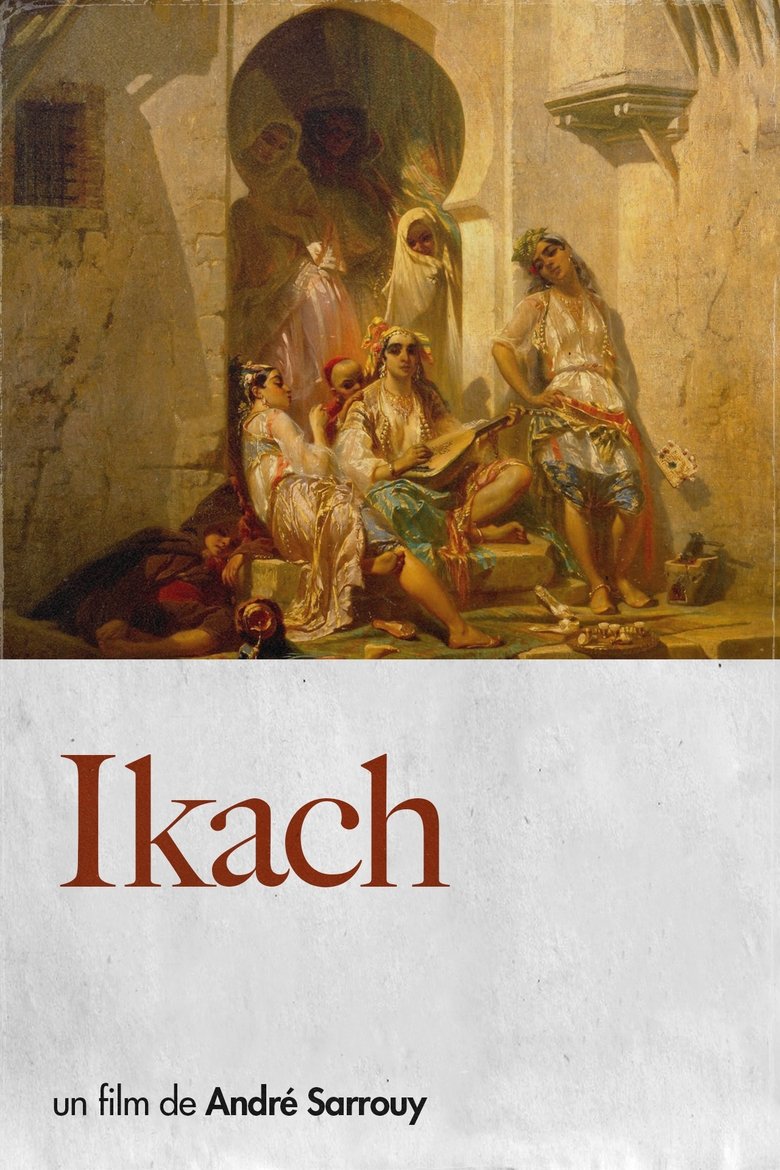
Ikach
Genres
Comedy
Overview
Ikach, is a farce in two acts in popular Arabic, written by André Sarrouy and adapted and directed by himself. A critique of marriage in colonial Algeria at a time when women were little taken into account. Cunning of women and stupidity of husbands, on an original soundtrack composed by Mohamed Iguerbouchène.
Details
Budget
$0
Revenue
$0
Runtime
0 min
Release Date
1937-01-01
Status
Released
Original Language
French
Vote Count
1
Vote Average
10
Cast
Meet the talented actors who bring the movie to life.
Rachid Ksentini
Brahim Dahmoun
Similar Movies
Explore movies similar to this one that you might also enjoy.
10.0
The Casbah of Algiers
The daily life and tribulations of colorful residents in the millennial popular district of the Casbah of Algiers.
1993-01-01 | ar
10.0
Elli Fat Mat
27 years after 1962, Antoine returns to Algiers...
1989-11-15 | fr
10.0
L'Obstacle
Algerian youth of the 1960s, straddling traditional South Mediterranean and Western culture and the desire for emancipation of younger generations to find true love.
1965-01-01 | fr
10.0
El Ouelf Essaïb
An Algerian music composer and his friends live a thrilling story, full of twists and turns.
1990-01-01 | ar
10.0
The Empire of Dreams
A stubborn director who wants to rediscover the Algiers of his childhood comes up against the “Hollywood” fantasies of his characters, non-professionals all hoping to be able to become “someone else”, at least for the duration of a film… Mise en abyme for a journey into megalomania…
1982-06-05 | ar
10.0
Crazy About Music
Fous de Musique by Jean-Charles Carlus (1957) is a musical comedy featuring Rouiched, Mahieddine Bentir and the famous Bendaoud orchestra. Shot during the Algerian War, the film was not released until after independence and was probably shown in Paris in cinemas intended for immigrant workers around 1967. Sources: Archives Numériques du Cinéma Algérien
1967-03-15 | fr
6.1
Quarter to Two Before Jesus Christ
In antique Rome, a simple pepboy for chars becomes involved in a coup against Cesar. Rahatlocum is a North African Roman colony where Julius Caesar came to spend an expensive holiday. The revolt rumbles among the small people who find a leader in the person of Ben-Hur Marcel.
1982-10-06 | fr
10.0
Hassan Terro au Maquis
While trying by all means to stay out of the bloody turmoil caused by the Battle of Algiers, Hassan, an honest and naive family man, is wrongfully accused of terrorism by the French colonial army in "Hassan Terro." After escaping in "The Escape of Hassan Terro," Hassan is forced to join the resistance in "Hassan Terro in the Maquis."
1978-01-01 | ar
4.8
War Italian Style
It's May 1943, and two Italian American soldiers, Joe and Frank, are searching the North African desert for a Nazi general called Von Kassler. Von Kassler's aide captures them, and arranges for them to escape with fake war plans. But, things don't go exactly as planned for either side.
1965-11-26 | it
6.0
Bakhit and Bakhita
2010-03-05 | ar
8.5
Hassan Terro's Escape
In 1957, the Battle of Algiers intensifies. Hassan, a peaceful resident of the Casbah, is mistakenly identified as a dangerous "terrorist leader," earning him the nickname "Hassan Terro." He is arrested, but the French occupation army secretly organizes his escape in the hope of tracking down the leaders of the resistance. In turn, the Algerian liberation army exploits Hassan's naivety to thwart the French military command and disperse its forces.
1974-01-02 | fr
10.0
Lumières
Long quest for a director specializing in commissioned films, who after a depression rediscovers his loved ones, his Casbah district, himself. Taken in hand, for a while, by his Islamist neighbor, it is above all the meeting with an old projectionist giving him a censored history of cinema and Algeria, which helps him to change, and to accept his own fantasies, embodied by Marilyn Monroe and the Andalusian.
1989-01-01 | ar
10.0
First Step
A modern couple seeks to find marital happiness in a context where Algerian society is taking the “first step” towards female emancipation. A woman becomes president of a popular municipal assembly. Will she find happiness ?
1980-01-02 | ar
10.0
The Adventures of a Hero
In one of the tribes of the Algerian Sahara, everyone awaits the arrival of the hero who will defend the rights of the poor. A man decides one day to put the mark of the "hero" on his newborn son and the whole tribe celebrates the arrival of this eagerly awaited messiah who came to save them. This false hero then grows up by assuming his role of savior. Filled with cynicism, he crosses the countryside and has a number of adventures.
1979-01-02 | ar
10.0
Take Your Ten Thousand Francs and Get Out
Two young Algerians born in France leave the Paris region to return with their parents to the village of their origins. They speak neither Arabic nor Berber. First barrier which isolates them from their new environment and which is further accentuated by the problem of generations, present here as in France. The social position of Algerian women posed to young emigrants is more immediately felt and proves to be a generator of conflict. Thanks to the plot, it is the whole problem of the reintegration of emigrants in their land of origin that the film poses and illustrates.
1981-01-02 | fr
10.0
Moussa's Wedding
Moussa, a young Franco-Algerian, returns to Algeria, but adapting to life in his country of origin proves difficult. Just as he is about to leave for France, he is called up for military service, which suits him fine because he is secretly in love with the beautiful Nacira.
1982-01-01 | ar
10.0
Ommi Traki
Ommi Traki is an elderly woman who is active and involved in everything, organizing everything in her family and neighborhood. Surrounding her are her husband Salah, who contentedly observes the results of his wife's interventions with a mocking air; her spoiled son Ali, a young man she still considers a child; the maid Zouzou; and others. The film is inspired by the famous Tunisian television series of the same name from the 1970s.
1973-01-02 | ar
8.7
Inspector Tahar's Holiday
Inspector Tahar and his apprentice are invited by Mama Traki, a popular Tunisian heroine, to spend their vacation in Tunis. Before leaving Algiers, they stop at a tourist complex where a murder has just been committed. The investigation full of surprises and twists and turns will take them to Tunis where they will find Ommi Traki and his family...
1972-01-01 | ar
8.2
Tahia Ya Didou !
Originally commissioned by the city of Algiers to promote tourism, Mohamed Zinet’s Tahia ya Didou blends documentary with fiction to create a poetic, acerbic and rapturous portrait of the director’s native city. The camera travels freely, through the port, market, streets and cafés, capturing everyday people, some of whom recur frequently enough to seem like protagonists. The nominal plotline follows a French tourist couple’s leisurely visit to the city, the man having previously served in the army during the Algerian war. As they walk around, his comments betray his mindset’s racist colonial prejudices, while his wife reiterates asinine clichés. Their unhurried wandering is interrupted when he comes across a blind man and realises that he tortured him during his army service. The film is punctuated with punchy sequences that show a poet named Momo delivering verse as an elegy for Algiers.
1971-01-02 | ar
10.0
The Honour of the Tribe
Like every year in Zitouna, a bear handler passes by. With his creature, he comes to challenge the small community. And like every year, it is Slimane El Mabrouk who defends the honor of the tribe. But this time, he dies, leaving two orphans, Omar and Ourida. Robbed of their inheritance, the children will grow up alone. The years pass, the French army settles in, and with it, the war. Mysteriously, one day, after the murder of a French legionnaire, Omar disappears into the bush, while his sister dies in childbirth. Omar will return to the village, much later, once independence has been acquired, as a representative of power and with this enigmatic formula: "You must know that the Revolution has not forgotten you". Personal revenge? Sincere desire to bring progress and modernity? ... The inhabitants of Zitouna, upset in their ancestral way of life, will not be long in having an answer to their questions.
1993-01-02 | fr