Loading

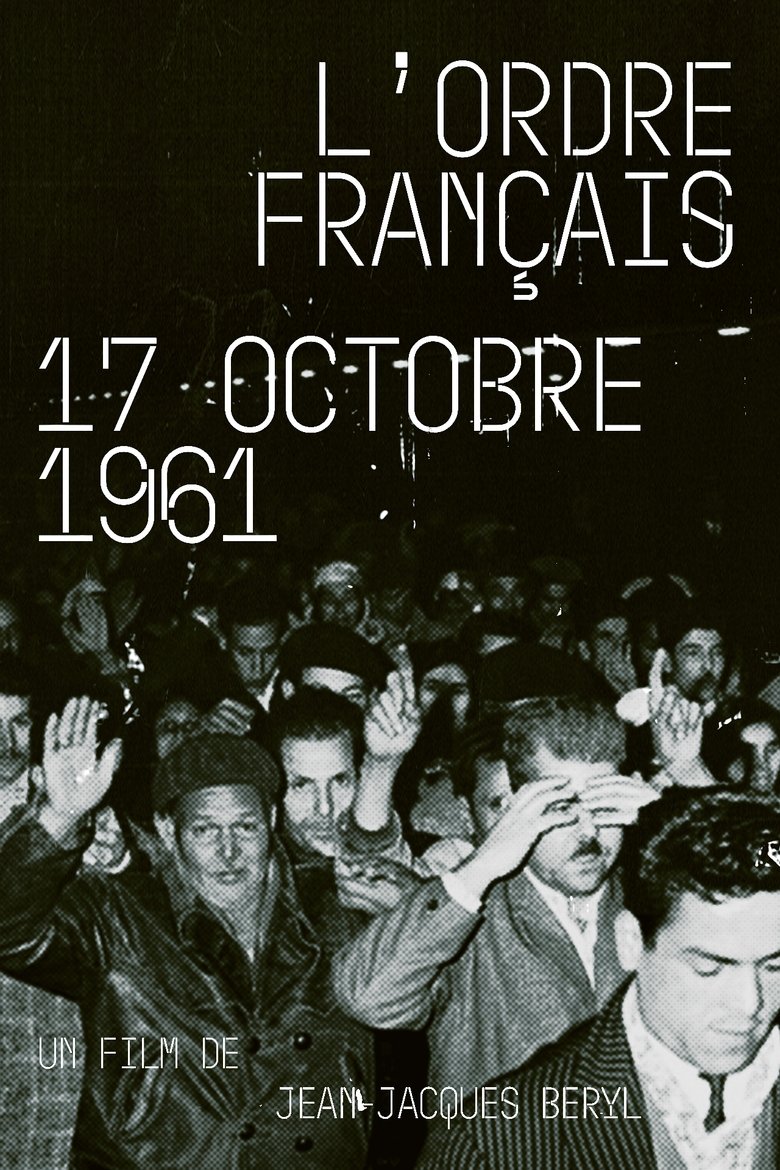
L'ordre Français : 17 Octobre 1961
Genres
Documentary
Overview
“In Algeria, we are restoring order, what we mean by French order,” declared Michel Debré, Prime Minister, under the presidency of Charles De Gaulle, in April 1956. It was, of course, order colonial in defiance of the republican order, in Algeria as in Paris where, on October 17, 1961, Algerians flocking from suburban slums were massacred by the police of prefect Maurice Papon, while they were peacefully marching for the independence of their country. On October 17, 2001, a commemorative plaque was placed in Paris on the Saint-Michel bridge: "In memory of the many Algerians killed during the bloody repression of the peaceful demonstration of October 17, 1961." A surge of racial hatred, less than 20 years after the roundup of the Jews in July 1942. An Algerian, victim of this roundup, told us, holding back his tears, "I still have nightmares."
Details
Budget
$0
Revenue
$0
Runtime
48 min
Release Date
2013-01-01
Status
Released
Original Language
French
Vote Count
1
Vote Average
10
Cast
Meet the talented actors who bring the movie to life.
Similar Movies
Explore movies similar to this one that you might also enjoy.
10.0
L'Avenir est ailleurs
2007-03-28 | fr
8.0
Two Lives for Algeria and All the Wretched of the Earth
In 1994, at over seventy years old, Gilberte and William Sportisse, threatened by the FIS, arrived from Algeria. Of Jewish faith, he of Arabic mother tongue, they formed a fighting couple, started for the independence of Algeria, always with an unshakeable faith in humanity. They enjoy recounting the participation of Algerian Jews in the Second World War and the struggle for Algerian independence. They provide us with previously unpublished information on the public and clandestine struggles of the Algerian Communist Party before and after independence, and on the repression of activists who, like William and Gilberte Sportisse, were tortured and imprisoned after Colonel Boumédiène came to power. The film is an ode to understanding between people of different origins or cultures and a tribute to a couple whose youthful character and enthusiasm still astonish.
2025-01-15 | fr
10.0
A Propos D'Un Crime
In 1967, Visconti came to Algiers for the filming of The Stranger with Mastroianni and Anna Karina. Camus, during his lifetime, had always refused to allow one of his novels to be brought to the screen. His family made another decision. The filming of the film was experienced in Algiers, like a posthumous return of the writer to Algiers. During filming, a young filmmaker specializing in documentaries Gérard Patris attempts a report on the impact of the filming of The Stranger on the Algerians. Interspersed with sequences from the shooting of Visconti's film, he films Poncet, Maisonseul, Bénisti and Sénac, friends of Camus, in full discussions to situate Camus and his work in a sociological and historical context. “The idea is for us to show people, others, ourselves as if they could all be Meursault, or at least the witnesses concerned to his drama.”
1967-01-01 | fr
4.8
The Problem with Apu
In the history of “The Simpsons,” few characters outside the title family have had as much cultural impact as Apu Nahasapeemapetilon, the Springfield convenience store owner. Comedian Hari Kondabolu is out to show why that might be a problem.
2017-11-18 | en
10.0
La Bataille d'Alger, l'empreinte
Cheikh Djemaï looks back on the genesis of Gillo Pontecorvo’s feature film, The Battle of Algiers (1965). Through archive images, extracts from the film and interviews with personalities, the filmmaker retraces the journey of a major work - from the events of the Algiers Casbah (1956-1957) to the presentation of the Lion of 'Or causing the anger of the French delegation in Venice - which left its mark as much in the history of cinema as in that of Algeria.
2018-01-01 | fr
0.0
After the Apology
Suellyn thought the Department of Community Services (DOCS) would only remove children in extreme cases, until her own grandchildren were taken in the middle of the night. Hazel decided to take on the DOCS system after her fourth grandchild was taken into state care. Jen Swan expected to continue to care for her grandchildren but DOCS deemed her unsuitable, a shock not just to her but to her sister, Deb, who was, at the time, a DOCS worker. The rate of Indigenous child removal has actually increased since Prime Minister Kevin Rudd delivered the apology to the ‘stolen generations’ in 2008. These four grandmothers find each other and start a national movement to place extended families as a key solution to the rising number of Aboriginal children in out-of-home care. They are not only taking on the system; they are changing it…
2017-10-09 | en
0.0
History and Memory: For Akiko and Takashige
This film is a poetic composition of recorded history and non-recorded memory. Filmmaker Rea Tajiri’s family was among the 120,000 Japanese and Japanese Americans who were imprisoned in internment camps after the attack on Pearl Harbor. And like so many who were in the camps, Tajiri’s family wrapped their memories of that experience in a shroud of silence and forgetting. This film raises questions about collective history – questions that prompt Tajiri to daringly re-imagine and re-create what has been stolen and what has been lost.
1991-04-10 | en
0.0
Le Prince charmant est toujours blanc
The pupils of about fifteen secondary schools in the suburbs of Paris react to the projection of two short films taken from the series "No More Lies ! 12 perspectives on everyday racism". Their comments, questions and reactions are of course focused on the subject of racism, but they also take a stand about what it means to have two cultural identities. Is it enough to be born in France in order to feel French ? What is their vision of a society obsessed with the idea of integration? What do they expect of the future ? With their questions and their protests, they often put their finger on the heart of the issues at stake. Beyond fiction, we discover their reality...
2001-01-01 | fr
4.0
Raul Brandão was a Great Writer...
This film is an attempt to disclose if Raul Brandão has left any trace, in Nespereira, Gumarães.
2012-04-05 | pt
6.6
The Aryans
THE ARYANS is Mo Asumang's personal journey into the madness of racism during which she meets German neo-Nazis, the US leading racist, the notorious Tom Metzger and Ku Klux Klan members in the alarming twilight of the Midwest. In The ARYANS Mo questions the completely wrong interpretation of "Aryanism" - a phenomenon of the tall, blond and blue-eyed master race.
2014-04-29 | de
0.0
The day he decided to leave
My grandfather Tuiu decides for the second time to leave his house and start a life elsewhere, he lives with the street hardships, and the fact of leaving is linked to the depredation of that place.
2015-08-21 | pt
10.0
Le Grand Désert
In 1950, the explorer Roger Frison-Roche made a crossing of more than a thousand kilometers on the back of a camel with the photographer Georges Tairraz II, in the heart of the Sahara, from Hoggar then Djanet in Algeria to Ghat in Libya. From their journey they brought back a large number of color films and documents. Among thousands of photos, they selected 47 images which reflect the various aspects of these immense spaces which occupy a third of Africa in the book "The Great Desert". “The Great Desert, 1000 kilometers on camelback” is the eponymous 85-minute documentary of this epic, released in 1950.
1950-12-01 | fr
7.0
The Case of the Wrong Man
The documentary tells the story of Júlio César, a young Afro-Brazilian who was executed by the Police in the 1980s in Porto Alegre. The crime became notorious when the press published photos of Julius being put alive in the police car and arriving 37 minutes later shot and dead at the hospital.
2017-05-11 | pt
0.0
Ritual de Luz
2023-10-13 | es
3.5
I Remember Nothing
January 2011 : the revolution bursts in Tunisia, my father’s country. The Tunisian people scream in a rage and I, here in Paris, can feel their revolt vibrating in my heart.
2017-03-28 | fr
6.6
The Venerable W.
A view of the religious tensions between Muslims and Buddhist through the portrait of the Buddhist monk Ashin Wirathu, leader of anti-Muslim movement in Myanmar.
2017-06-07 | en
0.0
The Tulsa Lynching of 1921: A Hidden Story
Documents the race riot of 1921 and the destruction of the African-American community of Greenwood in Tulsa, Oklahoma. With testimony by eyewitnesses and background accounts by historians.
2000-05-31 | en
7.5
Ghosts: Long Way Home
After a spell cast by Grandma Faraway, the oldest son of a small family encounters the ghost of his late Grandma Maria still living in her old house, and they chat as they used to.
2019-10-18 | pt
0.0
My Memory Is Full of Ghosts
Like a visual elegy, My Memory Is Full of Ghosts explores a reality caught between past, present and future in Homs, Syria. Behind the self-portrait of an exsanguinated population in search of normality emerge memories of the city, haunted by destruction, disfigurement and loss. A deeply moving film, a painful echo of the absurdity of war and the strength of human beings.
2024-10-10 | ar
10.0
Expédition Hoggar 79
TSR documentary on the 1979 expedition to Algeria in the Atakor massif (Hoggar desert), organized by Geneva mountaineer Michel Vaucher and Jean-Blaise Fellay. The climbers make a dozen ascents including the famous summit of Adaouda (which means "finger" in Tamasheq, the Tuareg dialect), by several routes. Then a new route on the peaks of the southern Tezoulegs. They discover the volcanic geological characteristics of the Atakor massif and meet the nomadic inhabitants of the region, the Tuaregs, who are increasingly settling in the town of Tamanrasset.
1979-05-31 | fr