Loading
Currentzis conducts Beethoven Symphony No. 9
Genres
Music
Overview
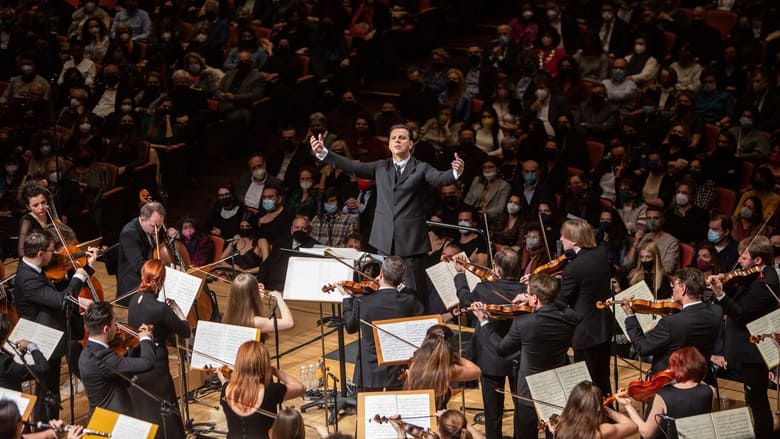
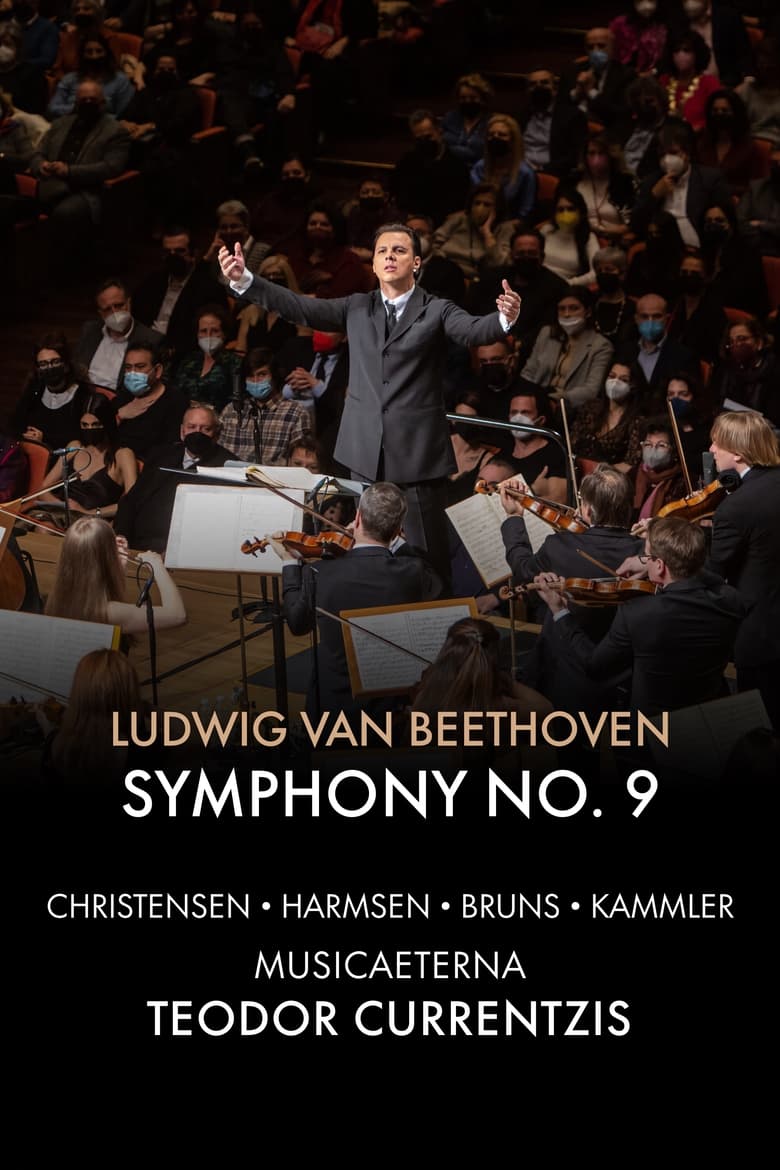
Ludwig van Beethoven headed for Symphony No. 9 literally his entire life. As early as the 1790s, he had an eye on Ode to Joy, perhaps the most well-known poem by Friedrich Schiller, written on the threshold of the French Revolution (1786). In his mature and, in particular, later years, the deaf composer with an acute ‘hearing vision’ increasingly distanced himself from conventional forms and genres and wrote parts beyond the possibilities of instruments of his day. He nurtured the idea of a symphony with a choir for at least several years. The history of the Ninth’s interpretations includes 200 years of staggering revelations and lingering stagnation. Performed by the musicAeterna orchestra, choir, and guest soloists under the baton of Teodor Currentzis, Beethoven’s opus magnum acquires the original poignancy and energy of a recent discovery.
Details
Budget
$0
Revenue
$0
Runtime
70 min
Release Date
2022-02-24
Status
Released
Original Language
German
Vote Count
1
Vote Average
10
Cast
Meet the talented actors who bring the movie to life.
Teodor Currentzis
Self – Conductor
musicAeterna
Self – Orchestra / Choir
Birgitte Christensen
Self – Soprano
Sophie Harmsen
Self – Mezzo-soprano
Benjamin Bruns
Self – Tenor
Johannes Kammler
Self – Baritone
Similar Movies
Explore movies similar to this one that you might also enjoy.
0.0
Beethoven · Die Symphonien
2013-09-23 | de
0.0
Vespro Della Beata Vergine
This large-scale live recording (Gardiner's second) was made in Venice's St Mark's Basilica. It captures the drama as well as the ceremonial aspect of the work, despite sometimes cloudy recorded sound.” Gramophone Classical Music Guide. “Gardiner's second [recording of the Vespers], spectacularly recorded live in St Mark's, has a punchy choral sound, near-operatic solo singing (Bryn Terfel and Alistair Miles are among the basses), emphatic enunciation, big contrasts and deliberate exploitation of the building's spaces. Its outright theatricality sets it apart from other performances.
1989-06-06 | en
0.0
Bruckner: Symphony No. 7
In Anton Bruckner’s 7th Symphony, the listener encounters a music characterized by great spaciousness and profound solemnity, a music which speaks of grief and lamentation, but also of their transcendence. With its monumental architecture and intensity of sound, the symphony has moved listeners ever since its triumphal premiere in 1884. The Guardian calls Daniel Barenboim’s London interpretation “Tremendous … Barenboim and the Staatskapelle seem to have this work in their systems, and the overall impression was of music unfolding organically at its own pace rather than of a work being self-consciously interpreted or led.” Anton Bruckner Symphony No. 7 in E major (original version) Daniel Barenboim, conductor Staatskapelle Berlin Recorded live at the Philharmonie Berlin, 25 June 2010
2014-03-31 | en
0.0
Bruckner: Symphony No. 6
Anton Bruckner’s 6th Symphony was written between 1879 and 1881: a very happy time in his life. Unlike most of Bruckner’s symphonies, the 6th was not revised. Of all his works, this one seems to come from a single source of inspiration. Bruckner himself called it his “boldest” symphony – probably due to its extreme degree of motivic, rhythmic and harmonic originality. This live recording of the seldom-performed 6th Symphony is the next instalment of the acclaimed Bruckner cycle by the Staatskapelle Berlin and Daniel Barenboim. Anton Bruckner Symphony No. 6 in A major (original version) Daniel Barenboim, Conductor Staatskapelle Berlin Recorded live at the Philharmonie Berlin, 22 June 2010
2014-01-06 | en
0.0
Bruckner: Symphony No. 8
“Clarity was one thing that made this performance a marvel. Another was the flexibility of Barenboim’s speeds…. The flexibility of Barenboim’s tempi meant that Bruckner’s charm – an often overlooked aspect of his genius – shone through, especially in the genial Trio.” (The Telegraph) Bruckner’s 8th is the last symphony completed by the Austrian composer. Many of his contemporaries regarded the symphony as “the pinnacle of 19th century music”. Even today, this monumental work fascinates listeners with its virtuoso orchestral technique, its immensity of sound, and its inexhaustible richness of detail. Symphony No. 8 in C minor (second version 1887-90, Robert Haas Edition) Daniel Barenboim, Conductor Staatskapelle Berlin Recorded live at the Philharmonie Berlin, 26 June 2010
2014-11-03 | en
0.0
The Great Waltz
Johann Strauss, Jr., a would-be composer of waltzes in mid-19th Century Vienna, attempts to thwart his father's efforts to prevent his success when the older man becomes jealous of his melodic skill.
1955-11-04 | en
7.0
Aida - Arena di Verona
The grand scale and magnificent acoustics of the Roman arena in Verona are ideally suited to the pageantry of Verdi's Egyptian opera, presented here in a staging that is true to the original 1913 production, framed by obelisks and sphinxes and filled with chorus and dancers. Chinese soprano Hui He has won international acclaim for her portrayal of the eponymous slave girl whose forbidden love for the war hero Radamés (Marco Berti, the experienced Verdi tenor) brings death to them both.
2013-11-05 | it
6.9
Mr. Holland's Opus
In 1965, passionate musician Glenn Holland takes a day job as a high school music teacher, convinced it's just a small obstacle on the road to his true calling: writing a historic opus. As the decades roll by with the composition unwritten but generations of students inspired through his teaching, Holland must redefine his life's purpose.
1995-12-29 | en
7.0
Die Deutschmeister
Young Stanzi who is visiting Vienna helps a young corporal and musician to become famous for his marching song "Die Deutschmeister".
1955-08-11 | de
0.0
Virtuoso: The Olga Samaroff Story
As America's first international woman concert pianist, renowned lecturer, author, music critic, famous conductor's wife and champion for equal rights for women in music, Olga Samaroff was at the center of a musical life that to this day embodies the imprint of her artistry and achievements. Her life story also portrays an era in our American cultural heritage that has largely been underserved in the documentary film genre. Texas-born Olga Samaroff a.k.a. Lucy Hickenlooper lived at a time when music was dominated by men and Old World prejudices----and she emerged as a leader among many. Against tremendous odds she rose from complete obscurity to be the most successful American woman concert pianist of the early 20th Century. - Lorri Holt, Frederica von Stade
2009-01-01 | en
0.0
Alphaville: The Breathtaking Blue Songlines
The video consists of nine tracks (ten if you count "Anyway", which is played over the closing credits), included in the album The Breathtaking Blue each of which accompanies a short film by a different director. The video for "Middle of the Riddle" won an Oscar for best short feature. Dedicated to the memory of Bruce Chatwin 1940-1988. Recorded and Mixed at Lunapark Studios, Berlin Except Romeos mixed at Townhouse, London
1989-01-01 | en
6.9
Gloria!
In late 18th century Venice, in a convent school for girls, Teresa, a student with prophetic gifts, joins forces with some amazing music-makers. They create a new kind of pop, bright and bold, and challenge the ancient and rigid system.
2024-04-11 | it
5.0
The Great Waltz
A musical based on the life and music of Johann Strauss, Jr.
1972-11-01 | en
6.4
Days of Happiness
Emma, a talented conductor and rising star on the Montreal scene, has a complicated relationship with her father and agent Patrick. She has to face up to her emotions and decide whether she wants to successfully combine her career with her love affair with Naëlle, a recently separated cellist and mother of a young son.
2023-10-20 | fr
4.0
Rock N' Roll
Chandramouli, an international drummer, goes to Chennai to help his friend in his new project. However, his life turns upside down when he falls in love with a playback singer.
2007-11-16 | ml
6.0
Bruckner: Symphony No. 4
Daniel Barenboim is an expert in exploiting the impact of cyclical performances of composers works: This time he focuses his sharp intellect on all six of Anton Bruckners mature symphonies. Der Tagesspiegel described Barenboim's performance of the works with the Staatskapelle Berlin on six nearly consecutive evenings in June 2010 as a superhuman accomplishment and went on to praise how: His Bruckner is conceived and performed very theatrically, like an opera without words. Bruckners famous Romantic Symphony No. 4 forms the prelude to a spectacular DVD series from Accentus Music and Unitel Classica, exploring Bruckners symphonic cosmos.
2010-02-16 | en
0.0
Brahms The Piano Concertos
Between 1981 and 1984 Leonard Bernstein recorded nearly all of Brahmss orchestral works with the Wiener Philharmoniker to honor the 150th anniversary of the composer's birth in 1983. For the concertos, Bernstein enlisted the services of some of the finest Brahms interpreters of the time: the violoninst Gidon Kremer, the cellist Mischa Maisky and the pianist Krystian Zimerman. Leonard Bernstein, Krystian Zimerman, and the Wiener Philharmoniker, it's very hard to get a better group of musicians for these masterpieces. Mr. Zimerman and Mr. Wolfgang Herzer's piano cello duets in the third movement of Brahms' second is simply tearful.
1984-12-11 | en
0.0
Bruckner Symphony No. 9
With nearly 450 years of tradition, the Staatskapelle Berlin is one of the oldest orchestras in the world. Daniel Barenboim has served as its music director since 1992, and in 2000 the orchestra appointed him Chief Conductor for Life. Having already performed important cycles such as Beethoven, Brahms and Schumann together, Daniel Barenboim and the Staatskapelle turned their focus toward Anton Bruckner's last six Symphonies, performed in the Philharmonie Berlin in the course of only one week in June 2010. This music is more serious and more significant than one had thought, the Berliner Zeitung summarized in its review of Daniel Barenboims celebrated Bruckner cycle with the Staatskapelle Berlin. Bruckners unfinished Symphony No. 9 brought to an end, in a poignant manner, the work of one of the greatest symphonic composers of the Classic-Romantic era.
2010-02-02 | en
0.0
Bruckner: Symphony No. 5
The Süddeutsche Zeitung summed up this highly acclaimed performance of Bruckner's monumental Fifth Symphony by saying: Both Bruckners belief in God, as it majestically wells up out of the chorale of the Fifth, and his deeply tragic world view, collide with one another in Barenboims interpretation. The operatic experience of the conductor was almost tangible, revealing the sheer dramatic instrumental battle between Bruckners God and the Devil between heaven and hell without betraying Bruckners unerring sense of striking proportions. The release of this contrapuntal masterpiece (as Bruckner, not without pride, referred to this work) is part of Daniel Barenboims Bruckner cycle with the renowned Staatskapelle Berlin.
2010-06-15 | en
0.0
Europakonzert 2008 from Moscow
The Berliner Philharmoniker’s European Concert, held each year on 1 May, is invariably an international highlight. Performing in 2008 in Moscow's renowned Tchaikovsky Conservatory, the orchestra under Sir Simon Rattle presented outstanding performances of works by Beethoven, Stravinsky and Bruch, whose Violin Concerto featured one of today’s most fascinating artists, the Russian violinist Vadim Repin. Stravinsky: Symphony in Three Movements Bruch: Concerto for Violin No.1, op.26 Beethoven: Symphony No.7 in A major, op. 92
2008-05-01 | de