Loading

Estos muros
Forced labor during Franco's dictatorship
Genres
DocumentaryHistory
Overview
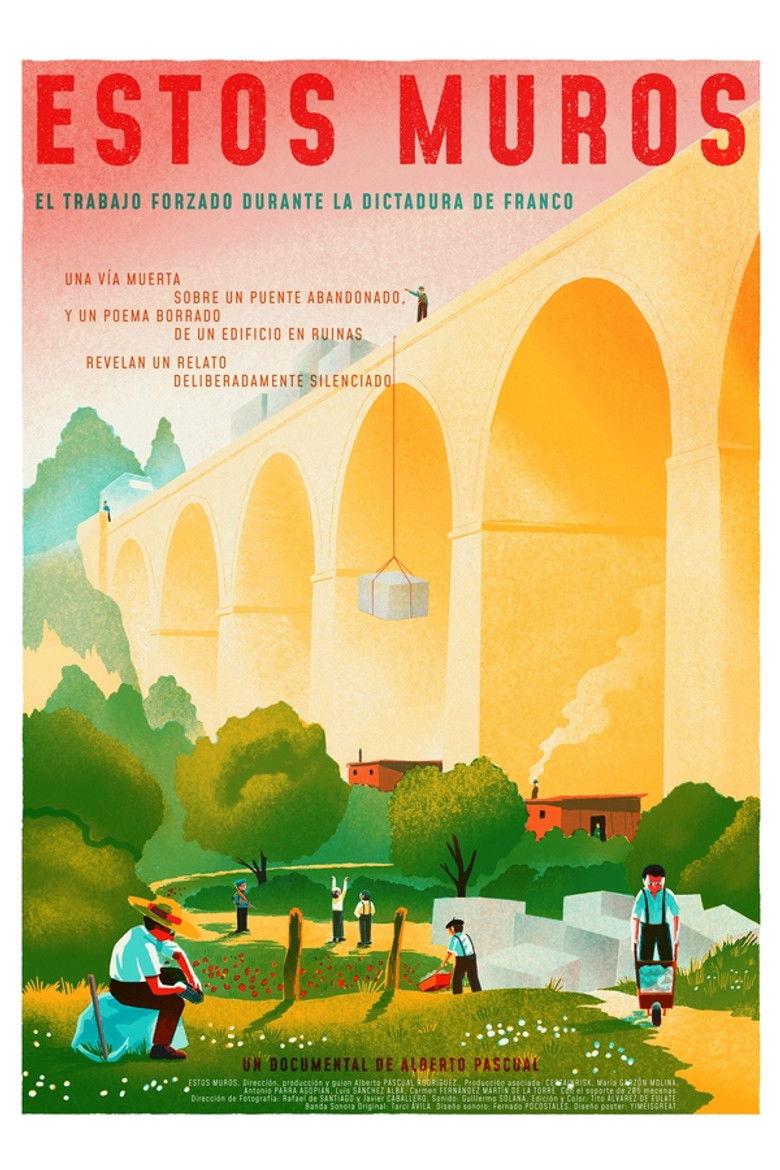
In the mountains of Madrid, Spain, a railway track on an abandoned bridge and a poem erased from the wall of a ruined building reveal a deliberately silenced story: the system established by Franco's dictatorship after the civil war (1936-39) that allowed hundreds of companies to use thousands of convicted Republicans as slave labor.
Details
Budget
$0
Revenue
$0
Runtime
68 min
Release Date
2021-10-01
Status
Released
Original Language
Spanish
Vote Count
1
Vote Average
8
Cast
Meet the talented actors who bring the movie to life.
Fernando Colmenarejo
Self - Archaeologist
Álvaro Falquina
Self - Anthropologist
María García Alonso
Self - Social Anthropologist
Carlos Hernández de Miguel
Self - Historian
Fernando Mendiola
Self - Historian
Anna Miñarro
Self - Psychologist
Juanjo Olaizola
Self - Historian
Alicia Quintero
Self - Historian
Similar Movies
Explore movies similar to this one that you might also enjoy.
10.0
The Conscience
Petrograd, Soviet Union, 1920s. Boris Letush, devastated by a personal tragedy, feels the need to put his conscience and his principles before the demands of the cruel system he serves, where law and justice are systematically ignored.
2021-06-15 | ru
0.0
Toma de Belchite y Teruel
1937-08-23 | es
9.0
Mysteries of The Underworld Cordoba
National Geographic follows archaeologist and explorer Fabio Amador on a fascinating voyage to unveil the ancient mysteries that lie beneath the modern streets of Cordoba, which dates back some 2,000 years. Fabio joins archaeologists and historians in the field as they use state-of-the-art technologies to discover and recreate Cordoba's forgotten past.
2019-12-15 | es
6.7
Jakob the Liar
In 1944 Poland, a Jewish shop keeper named Jakob is summoned to ghetto headquarters after being caught out after curfew. While waiting for the German Kommondant, Jakob overhears a German radio broadcast about Russian troop movements. Returned to the ghetto, the shopkeeper shares his information with a friend and then rumors fly that there is a secret radio within the ghetto.
1999-09-16 | en
7.0
I Invite You to My Execution
As Russian writer Boris Pasternak (1890-1960) thinks it is impossible that his novel Doctor Zhivago is published in the Soviet Union, because it supposedly shows a critical view of the October Revolution, he decides to smuggle several copies of the manuscript out of the country. It is first published in 1957 in Italia and the author receives the Nobel Prize in Literature in 1958, which has consequences.
2019-10-30 | fr
6.0
Històries de Bruguera
The history of Bruguera, the most important comic publisher in Spain between the 1940s and the 1980s. How the characters created by great writers and pencilers became Spanish archetypes and how their strips persist nowadays as a portrait of Spain and its people. The daily life of the creators and the founding family, the Brugueras. The world in which hundreds of vivid colorful paper beings lived and still live, in the memory of millions, in the smile of everyone.
2012-04-20 | es
0.0
O resplandor das Atochas
The memory of a defeat, a barbarism: the destruction at the dawn of the civil war of people who fought for freedom, a group of anarchists from A Coruña located in the Atochas area. Through valuable witnesses and historical images a reconstruction of a metaphorical episode in the history of the country. This projection is made in collaboration with its author and the Commission for the Recovery of Historical Memory.
2007-01-01 | gl
0.0
Del olvido a la memoria. Presas de Franco
Documentary in which ten republican women remember their time in Franco's prisons. “Some put wedges in her nails; my sister-in-law has currents on her fingers and nipples; some have been raped”; “Since they hit first and then ask questions, they hit me.” “Baby, they have given us the death penalty. I told him: but, Virtudes, they will commute you!". These are some of the testimonies of ten Republican women in Franco's prisons that Tomasa Cuevas, a former member of the Communist Party, collected on an old recorder hidden in her bag so that they would not be lost in oblivion.
2007-01-01 | es
6.8
Salvador (Puig Antich)
The story of Salvador Puig Antich, one of the last political prisoners to be executed under Franco's Fascist State in 1974.
2006-05-23 | ca
6.0
Kautela, Photographer
After the discovery of a suitcase hidden in the family home of Francisco Martínez Gascón, known as Kautela, a photojournalist who lived through the Spanish Civil War from the perspective of the rebel side, his granddaughter decides to carry out an investigation into his life and work.
2022-10-22 | es
0.0
Voces contra el silencio
A documentary about the recovery of the historical memory of the Malaga town of Archidona, a journey through the history of Archidona from the Second Republic to the last years of the post-war period. A work that speaks, above all, about people, experiences, emotions and feelings.
2006-01-01 | es
0.0
A Memoria nos tempos do wolfram
At the beginning of World War II, a mineral became necessary for the German state: wolfram. Galicia became “El Dorado” for many people who were looking for easy money and/or work in those hard years of the Spanish postwar. Miners, adventurers, guerrillas, civil guards, political prisoners, etc., lived together in the Galician mountains and intertwined their lives. This is the story of those people told by themselves.
2003-01-01 | es
6.0
The Ponzán Network
During the Spanish Civil War (1936-1939) and the Second World War (1939-1945), around three thousand people managed to elude their pursuers, and probably also avoided being killed, thanks to the heroic and very efficient efforts of the Ponzán Team, a brave group of people — mountain guides, forgers, safe house keepers and many others —, led by Francisco Ponzán Vidal, who managed to save their lives, both on one side and the other of the border between Spain and France.
2022-10-24 | es
5.0
Francisco Boix: A Photographer in Hell
In 1939, just finished the Spanish Civil War, Spanish republican photographer Francesc Boix escapes from Spain; but is captured by the Nazis in 1940 and imprisoned in the Mauthausen concentration camp, in Austria, a year later. There, he works as a prisoner in the SS Photographic Service, hiding, between 1943 and 1945, around 20,000 negatives that later will be presented as evidence during several trials conducted against Nazi war criminals after World War II.
2000-01-01 | es
0.0
La batalla de Guadalajara
Documentary about the battle of Guadalajara which took place in March 1937 during the Spanish Civil War and was the last major victory of the Republican Army.
2007-01-01 | es
0.0
La vida a través de Vega
The Asturian Valentín Vega is considered one of the most relevant photographers of the last century. He knew how to portray all the essential elements of daily life like no one else and at the same time exercise a devastating display of social criticism. After spending three years in prison for his political affiliation and managing to establish himself as a street photographer, he would continue to offer an unusual image of reality and daily life from the 1940s onwards.
2023-01-01 | es
7.9
Mirror
A dying man in his forties recalls his childhood, his mother, the war and personal moments that tell of and juxtapose pivotal moments in Soviet history with daily life.
1975-03-07 | ru
7.2
El campo para el hombre
"El campo para el hombre" was a politically militant documentary about the small holdings of land in the north of Spain and the large estates in the south of the country. This film portrays the exploitation and misery of the Spanish peasants, but also their class-consciousness and their will to fight for their rights and freedom. The film was shot in the late years of Franco's dictatorship, so it was made in secrecy (the directors were connected to the Spanish Communist Party).
1975-01-01 | es
0.0
Exile Diaries
A documentary made with homemade videos of the spanish exiled due to the dictatorship in Spain from 1939 to 1977.
2019-10-27 | es
0.0
La sombra de las ideas
During the Franco regime, the prisons are filled with thousands of people with artistic ideals.
2010-01-01 | en